Banking & credit unions
Branch security systems for San Diego banks and credit unions
Your security programme and your examiners set the requirements. Our job is to build to them, document what every position actually covers, and be honest about the parts that are somebody else’s trade.
Banking
Your programme sets the requirements. We build to them
Financial institutions are used to vendors arriving with a compliance pitch, so it is worth opening by saying what we are not. We do not interpret your regulatory obligations, we do not hold ourselves out as knowing what your examiner expects, and we will not tell you what your regulator requires. A vendor who does that is either repeating something they read or inventing it, and either way the institution carries the consequence.
What we do is build to the requirements your security programme already sets, document what every position actually covers, and be straightforward about the parts that belong to another trade. That documentation is usually the thing that is missing. Plenty of branches have adequate coverage and no current record of what each camera sees, which turns every examination and every footage request into an exercise in rediscovery.
The devices themselves are rarely the difficult part. The arrangement around them is: a teller line, a vault vestibule, a staff entrance, a rear service door and an ATM each have a specific job for a specific position, and the useful system is the one where somebody decided what each position had to produce before it was mounted.
Across a branch network the thing that matters most is that footage can be produced the same way everywhere. A request that takes ten minutes at one branch and two days at another is a process problem, not a camera problem, and it is worth designing out at the start.
That is with us. We will come back to arrange a survey. If it is urgent, call (858) 222-7547.
- CSLB C-7 #976737
- BSIS ACO #7501
- CMMC certified
- SAM.gov registered
- Est. 2008
Where we start
Your programme sets the requirements. We build to it.
Financial institutions are used to vendors arriving with a compliance pitch, so we will open by saying what we are not. We do not interpret your regulatory obligations, we do not hold ourselves out as expert in the requirements that apply to banks or credit unions, and we do not sell a system on the basis that it makes you compliant with anything. Your institution has a written security programme and a designated security officer, and your examiners assess you against that. Those are the requirements. We are a contractor.
Everything below is written on that basis: operational detail about branches, ATMs, vaults and cash handling, with the regulatory questions pointed firmly back at the people who own them.
Where our part starts
The contractor your security officer hands a specification to
A vendor who tells a credit union what its regulator requires is either repeating something they read or inventing it, and either way the institution carries the consequence while the vendor carries none of it. That is not modesty on our part; it is the only honest position available to a low voltage contractor.
What we bring instead is the part that is genuinely ours: designing positions that produce identification, building a duress and intrusion path that works and is tested, controlling the doors that need attribution, and documenting all of it in a form your own programme can reference. When somebody asks what a given camera covers, how long footage is held, who can view it and who can export it, the answer should be a document.
How the positions are specified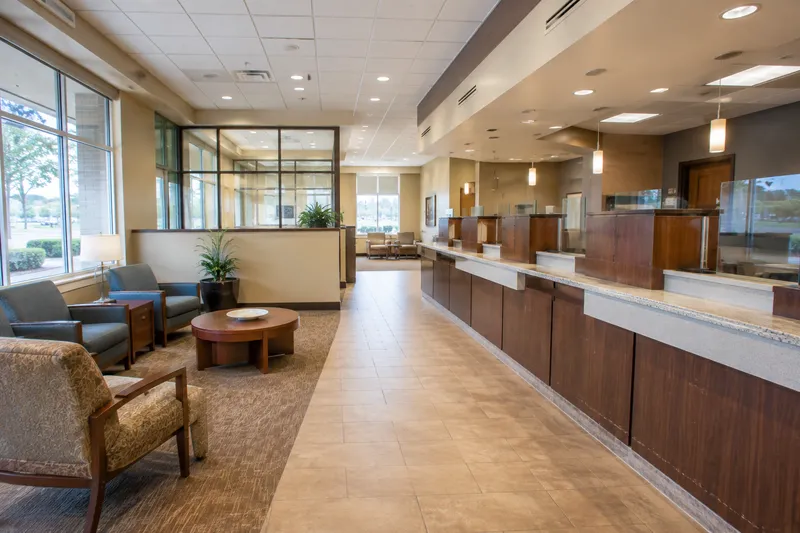
Positions
Six positions that carry a branch
Each has a different job, and the job decides the camera, not the other way round. Broad coverage of the banking hall is not on this list, deliberately.
The teller line
The position that carries the identification burden, because a person at a teller window is close, stationary and square-on for longer than anywhere else in the building. Framed on the transaction and the person.
The entrance
The one point everybody crosses, in a predictable direction at walking pace, which makes it the second realistic identification position. Sun through a glazed frontage is the constraint here, and it is the reason entrance cameras so often produce silhouettes.
The ATM surround
A separate design problem in its own right. Backlit by day, unlit at night, user close and looking down. Offset position, its own lighting, and honesty at survey about which machines can realistically produce identification.
The vault vestibule and cash room
About the access record more than the picture. Credential on the door, camera on the door, not in the room, and the log that lets a discrepancy be investigated from a time, not from suspicion.
Night-drop and drive-through
The parts of the property that stay accessible when the branch is closed and nobody is inside. Vehicle angles, low light and a public who arrive out of hours make these the positions most worth watching live.
The staff entrance and opening routine
Where somebody is most exposed, arriving alone before the branch opens or leaving after it closes. Coverage of the approach as well as the door, and a duress provision.
Duress and panic
The device is trivial. The arrangement around it is not.
Duress provision is the part of a branch system most often specified as a product and most often failing as a process. Mechanically it is simple: a fixed device at the teller position, the desk and the manager’s office sends a signal that is deliberately silent in the branch, so nothing in the room indicates it has been used. That signal reaches the monitoring centre, and everything that matters happens after that point.
What decides whether it works is the arrangement, and the arrangement is your institution’s to define. Who is notified and in what order, what is verified before anybody is dispatched, what your own staff are trained to do and not do, how your arrangement with law enforcement works, and how accidental activations are handled without eroding the response — those come from your security programme. We build the path, test it, and re-test it at service visits. We do not promise a response and we do not quote a time, because neither would be ours to promise.
The two points that are ours
Reachable by somebody who cannot move or look down
Placement first. A duress device has to be reachable by somebody who cannot move, cannot look down and cannot appear to be doing anything — which rules out most of the positions people initially suggest, and rules out anything requiring a keyboard.
Verification second. Where the duress path is supported by cameras, an operator can look at the branch before anybody acts on the signal, which is the difference between an assessed report and a bare activation. Egress is never affected by any of it: getting out of a controlled door we install is free and mechanical whether the system has power, a network, a working controller or none of those.
Panic and duress devices in full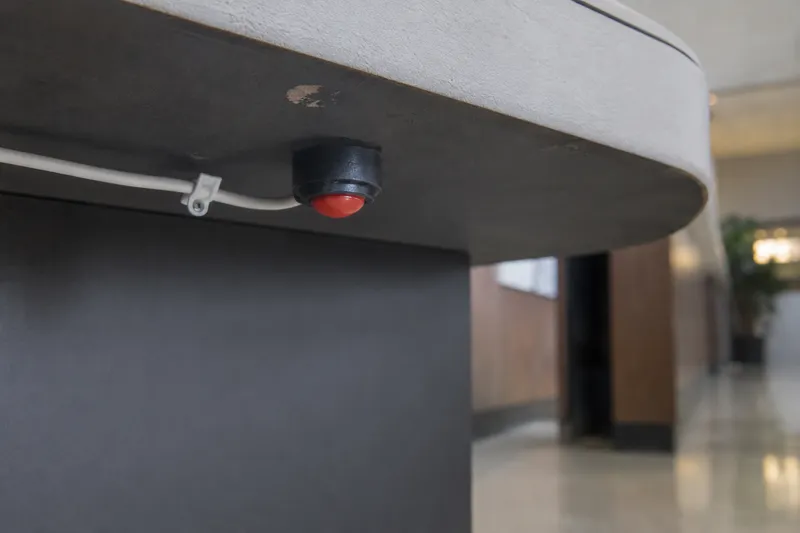
Scope
What is ours, and what belongs to another trade
Branch projects go wrong at the seams between trades more often than anywhere else, so it is worth setting out exactly where our scope stops.
- Ours. Camera design, installation and commissioning; recording, retention and the export process; access control on staff, vestibule, cash room and back-of-house doors; intrusion detection; the duress and holdup path; the intercom at a controlled door; and the cabling and network underneath all of it.
- Not ours: the vault and the safe. Construction, doors, locks, time locks and their servicing are a specialist trade. We cover the vestibule and the door with cameras and credentials; we do not touch the vault itself.
- Not ours: the ATM. The machine, its cash handling, its own internal camera and its network belong to whoever supplies and services it. We design and install the surround coverage and the environment around the machine.
- Not ours: the fire alarm. No C-10, no C-16, on any site and without exception. Coordinated with your own licensed fire alarm contractor, not performed or monitored by us.
- Not ours: regulatory interpretation. What your institution is required to do sits with your security officer, your counsel and your examiners. We do not advise on it, certify anything for it, or claim expertise in it.
- Not ours: guarding. Where a branch genuinely needs a physical presence, that is coordinated under the private patrol operator licence, BSIS PPO #121089, held by Guardian Integrated Security, Inc. San Diego CCTV Pros is a DBA of Guardian — the same company under its other licence, not an outside referral. Guard work is Guardian's side of the business; we do not quote guard hours.
We also make no certification claim of any kind about ourselves or the equipment. A licensed contractor and a licensed alarm company operator is the whole of what we are. Two numbers, both on a public register, both worth pulling before you shortlist anyone.
Footage that can be produced, across every branch the same way
The value of a branch system is realised at the moment somebody asks for footage — an investigator, an insurer, your own audit function, a member disputing a transaction. What determines whether that goes well has very little to do with camera specification and almost everything to do with decisions taken at install and never revisited.
Retention is first. Requests arrive late, and a recorder holding less than the period your programme calls for will have overwritten the event before anybody asks. What that period should be is set by your institution, not by us; we size the storage to it and tell you plainly what the sizing assumes, so it is a decision, not a default. Accurate system time is second, because footage has to line up with a transaction record, and a drifted clock produces an account that cannot be aligned with anything.
The most neglected part
A clip only one person can produce is not evidence
Who can view, who can export, in what format, and how each export is recorded should be set up at commissioning and written down — which also means access is removed the day somebody leaves.
Across a branch network that argument becomes one argument for standardising. Networks accumulate systems through acquisitions, refits and per-branch budgets, so a footage request currently depends on which branch it came from and who fitted it. One platform, consistent camera naming, the same retention everywhere and per-branch permissions turns eleven different answers into one.
What a platform choice actually settles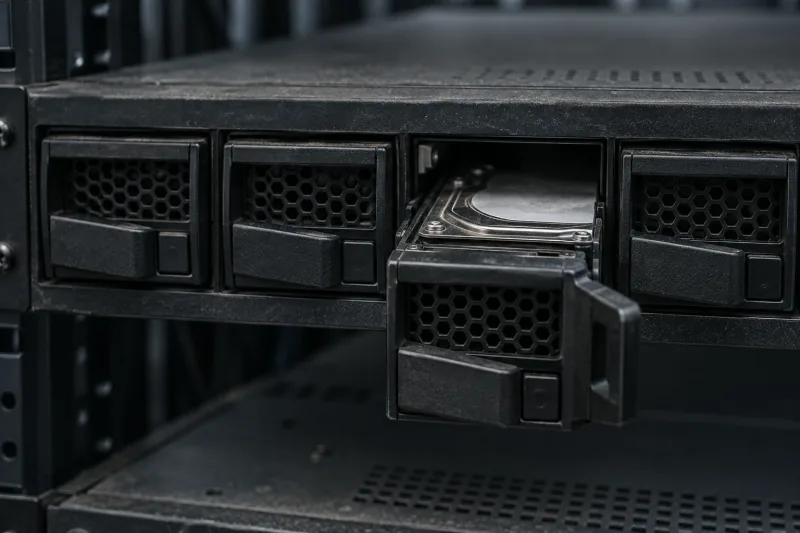
The rest of the system
What a branch usually needs
- Camera design and installation. Teller line, entrance, ATM surround, vault door, night-drop and staff entrance, each specified against what it has to achieve in the light it actually has. That is commercial security camera installation.
- Doors that carry attribution. Staff entrance, vault vestibule, cash room and back of house on per-person credentials and schedules, with exportable logs and free mechanical egress throughout. That is commercial access control.
- Intrusion, duress and holdup. Monitored intrusion verified against the cameras, and a silent duress path built and tested to the procedure your programme defines. That is commercial alarm monitoring.
- Somebody watching the closed branch. An operator able to see an activation and speak into the space during closed hours, which matters most where a night-drop, drive-through or ATM vestibule stays publicly accessible. That is remote video monitoring.
- Controlled entry at the staff and service doors. A video intercom so whoever answers can see who is there before releasing anything. That is video intercom and door entry.
- Keeping it working, and proving it. Drives fail quietly, retention drifts, cameras are knocked during a refit and a duress device that has never been tested is an assumption. That is CCTV maintenance and repair.
The cabling and network underneath is structured cabling, and in a branch it has its own constraint: the security system’s network normally has to be kept separate from the institution’s own, which is a design question settled with your IT function before anything is pulled rather than after. Work in an operating branch is scheduled outside banking hours and around your own access and escort requirements, agreed at survey and written into the programme.
If it is easier to start from the service than the vertical, the full list is on all commercial services, and the other verticals are on all industries.
Common questions
Branch security questions
No, and we would treat any vendor who says they can with suspicion. Your institution has a written security programme and a designated security officer, and your examiners assess you against that programme and against the obligations that apply to you. We are a low voltage contractor and a licensed alarm company operator — we are not examiners, not consultants to your compliance function, and not a source of regulatory interpretation. What we do is build and document to what your own programme specifies. Tell us the requirements your security officer has set, and we will design to them, show you exactly what each position covers, and give you the documentation your programme needs to evidence it.
RelatedPanic and duress buttons
The teller line, the entrance, the ATM surround, the vault or cash-room door, the night-drop and the staff entrance. The teller line and the entrance carry the identification burden, because they are where a person is closest, slowest and most square-on to a camera — everywhere else in a branch is compromise. The vault door and the cash room are about the access record, not the picture, and the ATM surround is a genuinely separate design problem because of the lighting and the angle. What matters less than people expect is broad coverage of the lobby floor: a wide view of a banking hall reliably tells you something happened and reliably fails to tell you who.
RelatedPanic and duress buttons
Mechanically, a fixed device — normally at the teller position, the desk and the manager’s office — sends a signal that is deliberately silent at the branch, so nothing in the room indicates it has been used. That signal goes to the monitoring centre, which handles it under the procedure your institution has agreed, and the procedure is the part that matters. The device is trivial; the arrangement around it is not. Who is notified, in what order, what is verified first, what your own staff are instructed to do, and what the arrangement with law enforcement is are all defined by your security programme. We build the path and test it. We do not promise a response, and we do not quote a time.
RelatedPanic and duress buttons
No. Vault and safe construction, doors, locks, time locks and their servicing are a specialist trade, and the ATM itself — the machine, its cash handling, its own internal camera and its network — belongs to whoever supplies and services it. What we do is everything around them: the camera positions covering the vault door and the ATM surround, the access control on the vault vestibule, cash room and staff doors, the intrusion detection and the duress path, and the recording and retention behind all of it. Where both trades are on a project, we coordinate with yours, not claiming a scope our licences do not cover.
RelatedPanic and duress buttons
Design attention, not a better camera. A walk-up ATM is a backlit position for most of the day and an unlit one at night, the user stands close and looks down, and anything mounted directly above produces a view of the top of a head. What works is a position offset from the machine, at a height and angle that sees a face on the approach, with lighting designed alongside it, not assumed. Cameras and lighting have to be specified together here or the result is a silhouette. We tell you at survey which of your ATM positions can realistically produce identification and which cannot, instead of covering them all identically and hoping.
RelatedPanic and duress buttons
Attribution, and the ability to remove it. A key tells you a door was locked; it does not tell you who opened the vault vestibule at seven in the morning, and it cannot be withdrawn from somebody who has left without rekeying. Credentials grant rights per person and per schedule — dual-control arrangements, opening and closing routines, and time windows can be reflected in the system, not only in the procedure manual — and they produce a log that can be exported when your own audit or your examiners want to see it. The discipline still has to exist: the system does exactly what somebody administers it to do, and an access list nobody reviews is a list of former employees.
RelatedPanic and duress buttons
It is the most common condition we find, and it is a problem mainly at the moment somebody needs footage. Branch networks accumulate systems through acquisitions, refits and per-branch budgets, so a request for video depends on which branch it came from and who installed it. For a branch network the case is regulatory as much as operational. One retention period applied everywhere is something you can state to an examiner in a sentence; five different ones are something you have to explain. The same logic runs through naming and permissions, and it is why a security officer should be able to review the network from where they sit. It also makes your own evidencing far simpler, because the documentation is one document.
RelatedPanic and duress buttons
Yes, and it is a different service from recording. A recorder documents what happened to a closed branch; it does not interrupt it. Monitored live coverage during closed hours puts an operator on the site who can see an activation, assess it against the cameras and speak into the space, which ends a considerable proportion of incidents at the point somebody realises a person is watching. Where a branch has a drive-through, a night-drop or an ATM vestibule accessible after hours, those are the positions that justify it, because they are the parts of the property open to the public when nobody is inside.
RelatedPanic and duress buttons
Covered: cameras, cabling, intercom and door hardware under CSLB #976737; intrusion alarm, monitored CCTV and access control under BSIS ACO #7501. Outside: fire alarm, which needs a C-10 or C-16 that we do not hold; and guard services, including a posted officer in a branch lobby, which need a Private Patrol Operator licence — that is PPO #121089, held by Guardian Integrated Security, Inc., the company San Diego CCTV Pros is a DBA of. For a branch network the second one comes up more than the first, so it is worth being plain about: we can install and monitor the systems that support your officers, and we cannot supply the officers.
RelatedPanic and duress buttons