Warehouse & logistics
Warehouse security camera systems in San Diego
Distribution centres, cold storage, freight yards and cross-border logistics facilities across San Diego County — dock doors, racking aisles, trailer yards and the hours when nobody is on site. Designed for the building you actually operate, not scaled down from an office.
Warehouse
A warehouse loses things in the gaps between systems
Ask a distribution manager what their security problem is and you rarely hear the word intruders. You hear that the numbers do not reconcile between receiving and dispatch, that a customer is disputing a short shipment nobody can now reconstruct, that a trailer sat in the yard over a weekend, and that something was signed for which does not appear to have arrived.
None of those are camera problems in the way the word is usually used. They are gaps — between the point goods stop being counted and the point they are counted again, and between the hours somebody is watching and the hours nobody is. What closes a gap is a position that can actually answer the question asked at the far end of it, which is usually weeks later and always specific.
That is why a survey here is organised around the operation rather than the building: dock doors, racking aisles, the yard, staging, and the transitions between them. High bays and long spans have their own consequences for lens choice and lighting, and a position that works at the dock will not work down an aisle at the same specification.
The yard is frequently the largest exposure and the least covered, because it is the part that looks like empty ground. If a discrepancy is only discovered at a cycle count, retention decides whether the footage still exists to settle it.
That is with us. We will come back to arrange a survey. If it is urgent, call (858) 222-7547.
- CSLB C-7 #976737
- BSIS ACO #7501
- CMMC certified
- SAM.gov registered
- Est. 2008
The operator's problem
A warehouse loses things in the gaps between systems
Ask a distribution manager what their security problem is and you rarely hear "intruders". You hear that the numbers do not reconcile between receiving and dispatch, that a customer is claiming a short shipment nobody can disprove, that something happened on the dock last Tuesday and the footage is either missing or unusable, and that the yard is full of trailers overnight with nobody watching them.
None of those are camera problems in the way the word is normally used. They are gaps — between the point goods stop being counted and the point they are counted again, between the hours the site is staffed and the hours it is not, and between three systems that share a building and do not share a clock. A generic install closes none of them, because a generic install is specified from a door count and a floor plan rather than from where the losses actually occur.
How this page runs
Organised the way a survey is
The rest of this page is organised the way a survey is: the problems first, then what each one actually requires. If you already know which part of the operation is hurting, that is the right place to start the conversation.
Start with the part that is hurting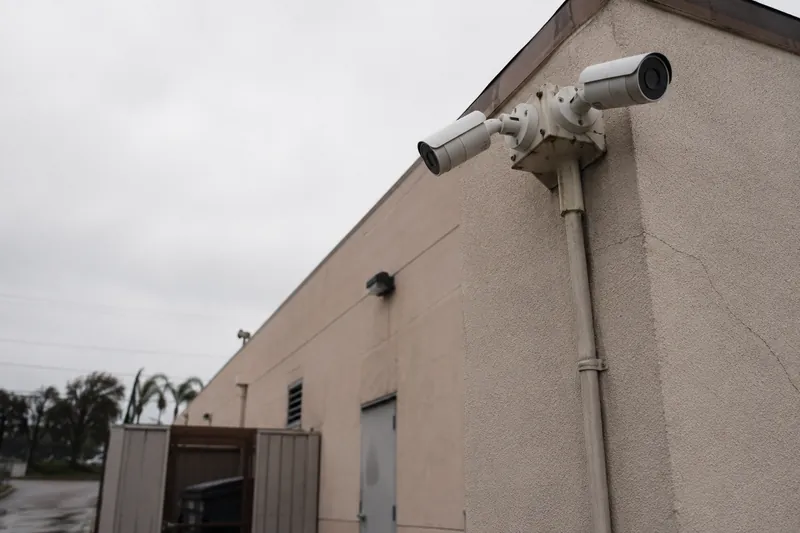
Where the losses happen
Six problems specific to distribution facilities
These are the ones that come up on nearly every warehouse survey we run, in roughly the order operators raise them.
The dock, during loading
The busiest and least-watched point in the building. Goods change custody at the threshold, a trailer blocks the sightline for hours at a time, and daylight through an open door defeats a camera without the dynamic range for it. Most dock systems we assess have one wide camera per bay and nothing covering the threshold itself — which is the view that settles what actually left.
Shrinkage between receiving and dispatch
Stock that arrives and does not ship, with no single event to point at. It is rarely solved by watching harder; it is solved by being able to reconstruct a specific item's path through the building, which means coverage of the transitions — receiving, put-away, pick faces, staging, dispatch — over general views of open floor.
Claims and disputes
A customer says the pallet was short; a carrier says it left that way. Without time-stamped footage of the load, that argument is settled by whoever is more insistent. This is the use case that most often pays for a system, and it depends on retention and time accuracy as much as on image quality — footage that has aged out or carries a drifting clock proves nothing. It is also what separates a genuine theft or break-in from an ordinary shipping error.
The trailer yard after hours
Large, dark, largely unlit and empty of people for most of the day. Fixed cameras record what happened; on a yard that frequently means reviewing an incident, not interrupting it. Yards are the part of a logistics site where recording alone is most often not enough — which is the case for after-hours coverage rather than a bigger DVR.
Safety incidents and liability
Forklift contacts, pedestrian-route near-misses, slips in a receiving bay, an injury claim filed weeks later. Footage is what establishes what happened, and it is equally capable of clearing your operation as implicating it — which is why coverage of traffic routes and pedestrian crossings earns its place alongside the theft-driven positions.
Who is in the building, and when
Multi-shift operations, agency staff, drivers, contractors and visitors all moving through the same doors. Keys cannot be revoked and do not produce a record; a badge can and does. Knowing who opened the dock personnel door at 3am is a different question from having footage of somebody opening it.
Why the building fights you
High bays, long spans and the dark
Hostile to the usual assumptions
Warehouses are hostile to the assumptions behind ordinary camera specification, and the reasons are physical, not technical: mounting height, racking that moves when the layout changes, and bright daylight behind the subject at every opening.
How the positions are designed
- Mounting height. A camera at high-bay height is far from its subject and looking down at a steep angle. That is fine for seeing that somebody is present and poor for identifying who, unless the lens and position are chosen for it. Height also makes every later adjustment a lift job, so getting it right at commissioning matters more than usual.
- Racking. Aisles are corridors with solid walls that move when the layout changes. A plan drawn on an empty floor plate looks fully covered and is not, and a reslot six months later can blind positions that were correct on the day. Wide overhead cameras are the usual first answer to a big floor plate and are the right answer less often than they are proposed — how we choose is in fisheye or multi-sensor.
- Backlight at every opening. Dock doors, roller shutters and personnel doors all put bright daylight behind the subject. Without wide dynamic range the result is a silhouette at precisely the point custody changes.
- Distance. Long spans and detached buildings push past copper's limit, so infrastructure — not camera choice — becomes the constraint that decides the design.
- Night. Most of what these systems are bought for happens when the site is dark and empty. Low-light performance and illumination are specification decisions, and a yard with no lighting needs to be treated as its own problem.
- Environment. Dust, washdown, vibration, cold storage and coastal salt air all destroy equipment specified for an office. Housings are chosen per position for what that position endures.
After hours
The yard is the exposure
The trailer yard is where a distribution site holds the most value in the open air, with the fewest people near it and the longest unobserved stretches. What matters there is not a perimeter breach but a vehicle moving at an hour when no movement is scheduled.
Watched live, not only recorded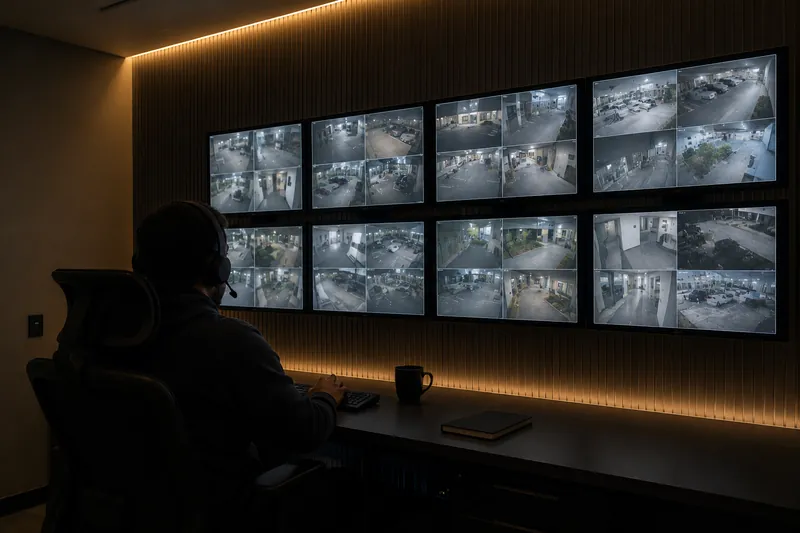
Problem to fix
What each problem actually requires
Nothing here is warehouse-specific technology. What is warehouse-specific is which combination you need and how it is designed for the building:
- Dock, aisle and yard coverage — positions specified against what each has to achieve, with the lens, mounting and low-light handling to match. That is commercial security camera installation, starting from a coverage plan instead of a count.
- Knowing who, not just what — badge or mobile credentials on dock personnel doors, employee entrances, offices and controlled stock areas, revocable the day somebody leaves. That is commercial access control, and tying it to the cameras is what connects a door event to a face.
- An alarm people trust — intrusion detection with camera-based verification, so an activation in a large open space can be checked, not guessed at. That is commercial alarm monitoring, and verification is also what protects your permit against repeat false activations.
- Somebody watching the empty hours — for yards and overnight periods where a recording after the fact is not the outcome you need. That is remote video monitoring.
- Infrastructure that carries it — Cat6a to PoE camera positions, fiber between buildings, communications rooms placed so no run approaches its distance limit. That is structured cabling, and on a campus it is the decision that shapes everything above it.
- Keeping it working — lenses fogged by dust, cameras knocked by forklifts and reach trucks, drives failing quietly, retention drifting below what your claims process assumes. That is CCTV maintenance and repair, and in this environment it is not optional.
If it is easier to start from the service instead of the problem, the full list is on all commercial services.
Fit to the operation
A system that fights the operation gets worked around
A security system that fights the operation gets worked around within a month. Doors get propped because the badge reader is on the wrong side of a route people actually walk; alarms get left disarmed because the first shift trips them daily; nobody pulls footage because the procedure takes forty minutes and one person knows it.
Credentials that match real shifts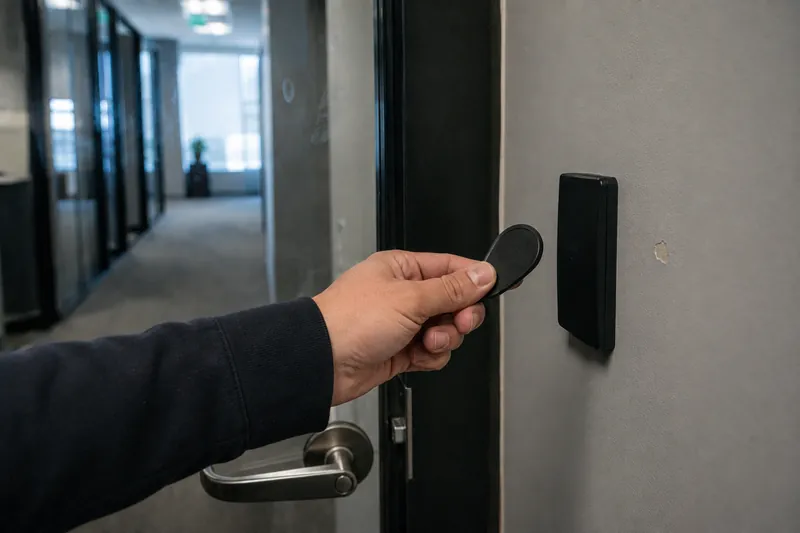
Operations
Fitting the system to how the site runs
So the design follows the operation. Arming schedules match real shift patterns including weekend and seasonal peaks. Credentials for agency staff and contractors are time-limited to the days they are booked. Camera naming matches what your people call the areas — dock numbers, aisle letters, gate names — rather than sequential device IDs, because the person pulling footage under pressure is a supervisor, not a technician.
On integration with your warehouse management or ERP systems, we will be straight — never expansive: some platforms expose interfaces that allow event data to be correlated with camera footage, and many do not. We assess what your specific systems support at survey instead of promising an integration and discovering the boundary afterwards. What is always achievable, and does most of the work in practice, is accurate time synchronisation across the camera, access and alarm systems — which is what lets a WMS timestamp be lined up against footage by hand.
Handover includes documented administrator access for your own team. You should not need to call your installer to pull footage for a claim.
San Diego logistics facilities
Dock door, racking aisle and yard coverage for distribution facilities, including the Otay Mesa cross-border corridor. We work across the county's industrial corridors — includingKearny Mesa, Miramar, Otay Mesa, Sorrento Valley — and out to the Riverside County line.
Cross-border and Otay Mesa
Industrial corridors
The county's established industrial areas run to older building stock — existing coax, legacy DVRs, and cabling installed by whoever was cheapest at the time. Most of our work here starts as an assessment of what is already there instead of a clean sheet. The business-park end of that stock is covered under commercial security in Sorrento Valley.
Coastal and inland conditions
Salt air corrodes housings and mounts on sites near the coast; inland valley yards put enclosures and IR illuminators under thermal stress. Same county, two different specifications, and it is decided per site.
Documentation and chain of custody
Facilities handling cross-border freight carry documentation and chain of custody expectations that ordinary distribution sites do not, and the footage requirement follows from that, not from a general wish for coverage. That is plate reading at the gate.
Common questions
Warehouse and logistics security questions
Because almost nothing about the building matches. Warehouse mounting heights put the camera far above the subject, which changes the lens and the angle needed to identify anyone, not merely see them. Racking blocks sightlines that looked clear on a floor plan. Dock doors create hard backlight — a camera facing an open door in daylight sees a silhouette unless it has the dynamic range for it. Yards are large, dark and largely unlit. Office-specification equipment installed in that environment produces footage that looks acceptable on the monitor wall and turns out to be useless the day somebody needs it.
RelatedRemote video monitoring
Two views per door, not one, in most designs: a wide view of the dock face showing the trailer and the surrounding activity, and a tighter view covering the threshold where goods physically cross. The threshold view is the one that resolves disputes, because it captures what left the building and when, and it is the view most often missing from systems installed to a door count. Backlight handling matters at every one of them, and so does the mounting position — a camera mounted where it was convenient, not where the sightline is, will be blocked by a trailer half the day.
RelatedRemote video monitoring
A yard is a different problem from a building. It is large, poorly lit, and there is normally nobody on site to respond, so fixed cameras alone tend to produce a recording of an incident instead of an interruption of one. The approach that works is layered: fixed cameras covering the gate and the approach routes, wider coverage across the yard itself, and — where the yard genuinely needs a response, not just a record — remote video monitoring so an operator is watching during the hours the site is empty. We will tell you plainly which parts of a yard can be covered well and which cannot.
RelatedRemote video monitoring
Not on its own, which is exactly the problem in a large open space. Motion detection covering a warehouse floor generates activations from stock movement, temperature swings, birds and equipment. The fix is verification over more sensors: cameras covering the detection zones so an operator can look at the zone that tripped and see whether there is a person in the building. That is the design behind commercial alarm monitoring on a site like this, and it is the difference between an alarm your people trust and one they learn to ignore.
RelatedRemote video monitoring
Yes, mainly in the infrastructure instead of the cameras. Copper has a hard distance limit, so buildings are linked on fiber, and each building typically needs its own communications room so no camera run approaches that limit. Separately grounded structures are another reason fiber between them is the right answer, not just a preference. Beyond that it is consistency: one platform, one naming scheme and one set of permissions, so footage from any building is legible to whoever pulls it. The infrastructure side is covered under structured cabling.
RelatedRemote video monitoring
Not as our own service line. We are a licensed alarm and low voltage contractor — cameras, access control, alarm and monitoring — and where a site genuinely needs a posted guard that is coordinated under the private patrol operator licence, BSIS PPO #121089, held by Guardian Integrated Security, Inc., of which we are a DBA — the same company under its other licence, and not something we present as ours. What we can do is reduce how much a site depends on a posted presence, by covering the hours and the areas where the alternative was somebody walking a yard in the dark.
RelatedRemote video monitoring
Yes to both, and both are the normal case. Most of the systems we take on were installed by somebody else, and most warehouses cannot stop shipping while work happens. That changes the sequence, not the standard: pathways surveyed against what is actually above the ceiling, cutovers staged so nothing goes dark mid-shift, and work around dock schedules instead of through them. Existing systems are assessed on their own merits under CCTV maintenance and repair — a system that is working is not automatically a system worth replacing.
RelatedRemote video monitoring
CSLB #976737 covers the cameras, the cabling and the door hardware. BSIS ACO #7501 covers the intrusion alarm and the monitoring of it. Between them that is a distribution building's whole security envelope except two things: the fire alarm, which needs a C-10 or C-16 we do not hold, and a posted guard on the yard gate, which needs a Private Patrol Operator licence — PPO #121089, held by Guardian Integrated Security, Inc., the company this brand is a DBA of. Both numbers check out on the state registers.
RelatedRemote video monitoring