Commercial alarm monitoring
Commercial alarm monitoring in San Diego
Central-station monitoring for commercial intrusion alarm systems across San Diego County — installed, taken over, verified against your cameras and serviced by a BSIS ACO licensed alarm company. Intrusion and burglary only, single site or portfolio.
Alarm Monitoring
An alarm is only worth what the response behind it is worth
An unmonitored alarm has exactly one mechanism: it makes noise and hopes somebody acts on it. On an industrial park at two in the morning, in a warehouse on a Sunday, or across an office floor over a holiday weekend, there is frequently nobody to hear it. The siren is not the security system. The procedure that runs after the signal leaves your building is.
So the questions worth settling before anything is quoted are about that procedure. When a device trips, the panel transmits a signal identifying your site and the specific zone. A staffed central station receives it and works the response plan agreed with you: attempt verification, contact the people on your call list in the order you set, and request law enforcement dispatch where the activation stands up. All of that is written down in advance rather than improvised on the night.
Verification is the part that decides how much the alarm is actually worth. An activation confirmed against a camera is a different thing from a bare signal, both for how your own people respond and for how a dispatch request is treated. If you already have cameras, the survey establishes whether they can carry that job.
We take over existing panels as well as installing new ones, and we work across portfolios. This is BSIS ACO-regulated work and we hold ACO #7501. Monitoring also produces a timestamped record of every activation, restore, open, close and test on your system.
That is with us. We will come back to arrange a survey. If it is urgent, call (858) 222-7547.
- CSLB C-7 #976737
- BSIS ACO #7501
- CMMC certified
- SAM.gov registered
- Est. 2008
What monitoring is
A siren nobody hears is not a security system
An unmonitored alarm has exactly one mechanism: it makes noise and hopes somebody acts on it. On a commercial site — an industrial park at 2am, a warehouse on a Sunday, an office floor over a holiday weekend — that assumption usually fails. The building is empty, the neighbours are empty, and the siren runs its cycle and stops.
Whether a monitored system is the right call for your site at all, and what the San Diego dispatch data actually shows about unverified alarms, is set out on monitored versus unmonitored alarm systems. What we do not do is dress that up. We will not quote you a response time or a dispatch time, because the part of that chain we control is the signal and the procedure — the arrival of a patrol car is a law enforcement decision governed by their own priorities on the night. Any alarm company quoting you a guaranteed arrival time is describing something they cannot deliver.
Monitoring replaces hope with a procedure
When a device trips, the panel transmits a signal identifying your site and the specific zone that activated. A staffed central station receives it and works the response procedure agreed for your account.
Attempt verification, contact the people on your call list in the order you set, and request law enforcement dispatch where the activation stands up. Every step of that is agreed in writing before the system goes live — see somebody watching, not only receiving for what that staffing model actually looks like.
The second output
A specific event at a specific door
Monitoring produces a timestamped record of every activation, restore, open, close and test on your system.
That record is what an insurer asks for after a loss, what tells you your night crew is disarming the panel at 4am and not 6am, and what turns "the alarm went off at some point over the weekend" into a specific event at a specific door.
The hours the record covers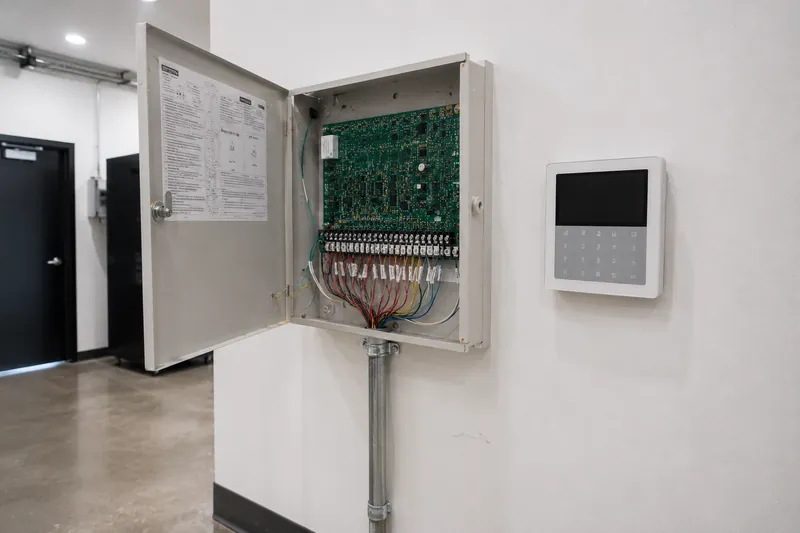
Detection
What actually detects an intrusion
Door and window contacts
The perimeter layer: a contact reports whenever a door or window opens. Cheap, reliable and the backbone of any commercial system. On roller shutters, dock doors and gates the hardware has to be specified for the travel and the abuse, which is where systems installed from a price list tend to fail first.
Motion detection
The interior layer, covering the space somebody has to cross once they are inside. Commercial environments need sensors chosen for the conditions — high ceilings, racking, heat sources, moving stock and animals all generate activations in a sensor specified for an office.
Glassbreak detection
For frontages, ground-floor glazing and display windows, where entry comes through the glass, not through the opening. Acoustic sensors listen for the specific signature of breaking glass, so coverage depends on placement relative to the glazing instead of on the room.
Duress and hold-up
A fixed button or a code that arms a silent signal — no siren, no indication to the person in the room. Appropriate wherever staff handle cash or open up alone, and it is a procedure as much as a device: the people who might use it have to know it exists and what happens after.
Environmental and equipment monitoring
Non-security conditions that still need somebody told at 3am: cold storage temperature, freezer failure, water where water should not be. Common on medical, food and cannabis sites, and reported through the same panel.
Panel and communication path
The panel is the part everything else reports through, and its communication path is the part that has to survive. Network and cellular reporting with one backing up the other; a single path is a single point of failure and is the first thing interfered with by anyone who knows what they are doing.
Verification
Video verification, and why an unverified alarm is a weak alarm
The overwhelming majority of alarm activations at commercial sites are not intrusions. They are staff arriving early, a contractor with a key and no code, a delivery driver at a dock door, a balloon or a heater in front of a motion sensor, or a door that no longer closes properly on its own. Everyone in this trade knows it, and it shapes how activations are treated by the people you want to respond to them.
Verification is the step that separates the real ones. It takes three forms, in ascending order of strength:
- Call verification. The operator calls the site and then your call list. Cheap, universal, and only as good as whether somebody answers a phone at 3am.
- Sequential detection. A second device confirming movement deeper into the building. Better, and it requires the system to have been designed in layers instead of as a ring of contacts.
- Video verification. The operator views the camera covering the zone that tripped and sees whether there is a person in the building. This is the strongest form available, and it converts an ambiguous signal into an observed fact.
Video verification only works if the cameras actually cover the detection zones, which is a design decision made when the two systems are planned together — not something retrofitted by pointing an operator at whatever cameras happen to exist. It is the clearest practical argument for having the alarm and the camera system designed by the same contractor. If your existing cameras are the weak half of that pairing, that is the subject of CCTV maintenance and repair.
Why false alarms are a commercial cost, not an annoyance
Every jurisdiction in San Diego County requires a permit for a monitored alarm system, and the permit belongs to you, not to your alarm company. In the City of San Diego the authority is the San Diego Police Department: SDPD alarm permit, Form 1067. Required before an alarm system is monitored; renewed annually. Unincorporated areas are administered by the Sheriff's Department, and each incorporated city runs its own scheme with its own rules —11 separate permitting authorities across the areas we cover, by our own count of the issuing agency for each city we serve. We tell you which applies to your address before your system goes on monitoring.
The reason this matters beyond paperwork is that repeat false activations carry consequences set by that authority, and they land on the permit holder. That is the honest framing of false-alarm reduction: it is not about avoiding embarrassment, it is about not degrading the response your site gets and not accumulating charges against your own permit. How rarely an unverified dispatch finds anything is measurable from SDPD's own call data, set out on false alarm statistics for San Diego.
The causes are consistent, and most are designed out, not trained out:
- Staff arriving before somebody disarms the panel — solved properly by tying arming to commercial access control, so a valid credential on the right schedule disarms on entry.
- Motion sensors specified for an office and installed in a warehouse, where racking, heat and moving stock generate activations.
- Doors that no longer latch, propped doors, and roller shutters whose contacts have drifted out of alignment.
- Codes shared with cleaners and contractors, so nobody can tell which activation was whom.
- Devices at end of life reporting intermittently, which is what regular testing exists to catch.
What we will not do is put a percentage on the improvement. We have no figure we can evidence, and quoting one would be inventing a number to make a sentence sound better.
Alarm, cameras and access control as one system
Most commercial buildings acquire these three separately, years apart, from different contractors. The result is three systems that share a building and nothing else — three consoles, three sets of credentials, three clocks that disagree, and nobody able to answer a simple question about what happened at a specific door at a specific time.
- Alarm and cameras. The activation and the footage of the zone that activated, retrievable as one record. This is what makes video verification possible and what makes an incident investigable afterwards.
- Alarm and access control. Arming and disarming driven by credentials on a schedule, which removes the largest single cause of false activations and tells you who disarmed the building, not merely that somebody did.
- Shared time reference. Unglamorous and decisive. If the panel, the recorder and the door controller disagree on the time, correlating them after an incident is guesswork and the evidentiary value of all three drops.
- One infrastructure underneath. All three run on the building's low voltage cabling, which is why structured cabling is worth getting right before the systems that depend on it are bought.
Where a manufacturer boundary means two systems genuinely will not integrate, we say so at survey. Some combinations of legacy panel and current platform have no supported path between them, and the honest options are a documented manual procedure or replacing one side — not a claim that they will talk to each other.
Scope of work
New systems, takeovers, and portfolios
New commercial installation
Survey, design against the building's actual weak points, panel and device installation under C-7 low voltage, programming, permit guidance for your jurisdiction, and commissioning device by device before the system goes on monitoring.
Takeover of an existing panel
Frequently possible without replacing hardware. We survey what is installed, establish whether it can be reprogrammed to report to a new central station, and tell you when a proprietary or unsupported panel means takeover is not the cheaper path after all.
Upgrading the communication path
The most common single upgrade on older commercial systems: moving reporting off a copper phone line onto network and cellular paths that back each other up, without replacing a panel that is otherwise perfectly serviceable.
Multi-site portfolios
Several buildings under consistent arming schedules, call lists and zone naming, so that a signal from any site is legible to an operator and to whoever you have on call — rather than each building carrying whatever conventions its original installer used.
After-hours and holiday coverage
Schedules that reflect how the site actually runs, including seasonal closures, shift patterns and the periods when a building is empty for days, not hours — which is when commercial premises are most exposed.
Service and testing
Scheduled testing that confirms every device still reports and every signal still arrives, battery and power supply checks, walk-testing detection coverage, and reviewing your call list against who actually works there now — the item that is most often years out of date.
Scope limits
What we are licensed for, stated plainly
San Diego CCTV Pros holds a BSIS Alarm Company Operator licence, ACO #7501 — the licence California requires to sell, install, service and monitor intrusion alarm systems — and CSLB #976737, a C-7 low voltage contractor's licence covering the wiring, devices and infrastructure side. Both numbers are checkable directly with their issuing agencies — the state, not us, is the authority here.
The boundary, and who we work for
Vagueness about scope surfaces at the worst possible moment
Our scope is intrusion and burglary. We do not hold a C-10 or a C-16, so anything falling under a fire contractor's licence is outside what we are permitted to install, service or monitor, and we coordinate with your own licensed fire alarm contractor, not taking it on. Contractors who are vague about that boundary are a liability to the building owner.
We work on commercial premises only — offices, warehouses, industrial, medical, retail, government and defence-adjacent sites — and not on private residences. Commercial monitoring carries permit obligations, multi-user arming schedules and procurement constraints that residential work does not.
The verticals we actually work in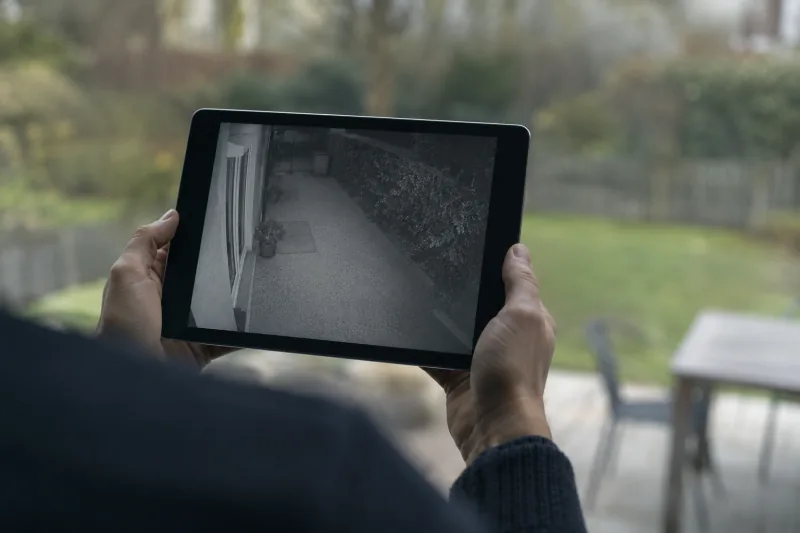
Common questions
Commercial alarm monitoring questions
Alarm monitoring means your intrusion alarm reports to a staffed central station instead of only sounding a siren on the building. When a detection device trips, the panel transmits a signal identifying your site and the specific zone that activated. An operator then works the response procedure agreed for your account — typically attempting to verify the activation, contacting the people on your call list, and requesting law enforcement dispatch where the activation stands up. An unmonitored alarm depends entirely on somebody nearby hearing it, caring, and knowing who to call.
A local alarm makes noise. That has some deterrent value and no reporting value: if the building is empty and nobody hears it, the event produces nothing except a noise complaint. A monitored alarm produces a timestamped record of what tripped and when, a documented response procedure, and a route to law enforcement dispatch. For a commercial site the record matters as much as the response — it is what your insurer asks for and what turns an incident into something investigable.
Verification is the step between an activation and a dispatch request. It can be a call to your site and your call list, a second detection device confirming movement through the building, or video verification — an operator viewing the camera covering the zone that tripped and seeing whether there is genuinely someone there. Verification matters because unverified activations are overwhelmingly false, and because law-enforcement agencies across San Diego County treat repeat false activations as a permit and cost problem for the permit holder. Video verification is the strongest form available and it depends on the camera system covering the detection zones, which is a design decision instead of an afterthought.
Yes, and the requirement belongs to you as the permit holder, not to your alarm company. In the City of San Diego the authority is the San Diego Police Department — SDPD alarm permit, Form 1067. Required before an alarm system is monitored; renewed annually. Other jurisdictions in the county administer their own schemes with different rules; unincorporated areas are handled by the Sheriff's Department, and each incorporated city runs its own. We tell you which authority applies to your address and what it requires before your system goes on monitoring, because an unpermitted monitored system is a problem the day it first activates rather than a paperwork issue later.
Usually, yes. Many commercial panels can be reprogrammed to report to a different central station without replacing the hardware, which is the cheapest path and the one we look at first. What forces replacement is a panel the manufacturer no longer supports, a proprietary panel locked to the previous provider, or a communication path that no longer exists — a substantial number of older panels still report over a phone line that the building has since given up. We survey the panel, tell you which category it falls into, and quote the takeover against that instead of defaulting to new equipment.
Over the building network, over a cellular communicator, or both, with the second acting as backup for the first. Path redundancy is the point: a single reporting path is a single point of failure, and it is the first thing an intruder who knows what they are doing interferes with. Copper phone lines, which older commercial systems still depend on, are the weakest option remaining — they are cut easily and are being withdrawn as a service. Which combination is right depends on your building, and it is settled at survey.
That is the configuration worth having. Tying the alarm to the cameras gives an operator something to verify against instead of a bare signal. Tying it to access control means a valid credential on the right schedule disarms the system on entry, which removes the most common cause of false activations at commercial sites — staff arriving before somebody remembers to disarm the panel. Where a manufacturer boundary means two systems genuinely will not integrate, we say so at survey, not after installation.
San Diego CCTV Pros holds a BSIS Alarm Company Operator licence (ACO #7501), which is the licence California requires to sell, install, service and monitor intrusion alarm systems, and CSLB #976737 — a C-7 low voltage contractor's licence — for the wiring side. Verify either with the agency that issued it. A C-10 and a C-16 are the two we do not hold. Our scope is intrusion and burglary only, and anything falling under a fire contractor's licence is coordinated with your own licensed fire alarm contractor, not performed or monitored by us. We would rather tell you that plainly than be vague about it.
Related services
Other commercial services
Access Control Systems
Card, fob and mobile credential systems — readers, controllers, electric locking hardware, and integration with the camera system.
Biometric Access Control
Fingerprint, facial and palm credentials for the commercial openings where a credential must not be transferable — server rooms, cash handling, controlled inventory and pedestrian gates. Installed under ACO #7501, with the template storage and retention questions settled at design.
CCTV Maintenance & Repair
Scheduled preventive maintenance contracts and on-call repair for commercial camera systems — including systems we did not install. Camera replacement, cabling faults, NVR and storage failures, firmware and retention audits.
Gate Access Control Systems
Access control at the vehicle gate and the perimeter — readers, keypads, mobile credentials, transmitters, telephone entry and loop and safety-device integration, wired and commissioned under C-7 and ACO. The gate operator itself is your gate contractor's; we coordinate with them.