Construction sites
Construction site security cameras in San Diego
High-value materials, no permanent power, and nobody on site after the last trade leaves. Jobsite coverage designed around the phase you are actually in.
Construction
Every assumption a normal install rests on is missing on a jobsite
There is no completed building to secure — the fence is the perimeter and it moves. There is often no permanent power and no network. The site is temporary by definition, so a permanent installation is hard to justify for something that will not exist in eighteen months. Which means the first design question is not what to cover, it is what the site can physically support at the phase you are in.
What makes it worth doing anyway is rarely the replacement cost of what goes missing. A reel of cable is cheap. The trade that cannot work on Monday because the cable is gone is a programme delay, and programme delay is the expensive part. That is the calculation a superintendent is actually making, and it is the one worth putting numbers against before deciding how much coverage to buy.
What a site loses also changes as it builds. Coverage designed once at mobilisation is aimed at the wrong things by fit-out, when the copper, the appliances and the finished materials arrive. So the useful arrangement is one that moves with the programme rather than one that is bolted down in month one.
Power and connectivity get settled first because they decide everything else. After hours is when jobsites are visited, which is why monitored coverage fits them better than most verticals — there is nobody on site to respond, and a recording of an empty site at 3am is not a response.
That is with us. We will come back to arrange a survey. If it is urgent, call (858) 222-7547.
- CSLB C-7 #976737
- BSIS ACO #7501
- CMMC certified
- SAM.gov registered
- Est. 2008
The contractor's problem
A site with no walls, no power and nobody on it
Every assumption a normal commercial install rests on is missing on a jobsite. There is no completed building to secure — the fence is the perimeter, and it moves. There is often no permanent power and no permanent network until well into the programme. The workforce changes weekly, so no access list stays current. And for most of the hours the site is exposed, there is nobody on it at all.
The exposures that drive it are consistent from site to site:
- Shutdown hours. Evenings, weekends and holiday closures, when the site is empty and predictable.
- A perimeter that is a fence. Temporary fencing is a boundary marker more than a barrier, and everyone involved knows it.
- Phase changes. The high-value area moves as the build progresses, and coverage that is not revisited ends up aimed at last year's problem.
- Unauthorised entry. An open site with excavations, plant and level changes is hazardous to anyone who gets in, which is a liability exposure as well as a security one.
- No infrastructure to build on. Power and connectivity have to be solved before coverage is even a question.
What is actually being bought
The loss is rarely the item
The site is temporary by definition, so a permanent installation is hard to justify for something that will not exist in eighteen months. What makes it worth doing anyway is that a reel of stolen cable is replaceable.
The trade that cannot work on Monday because the cable is gone is a programme delay, and programme delay is the expensive part. That is the calculation a superintendent is actually making, and it is why jobsite security is bought in terms of continuity, not asset value.
Coverage that leaves when the site does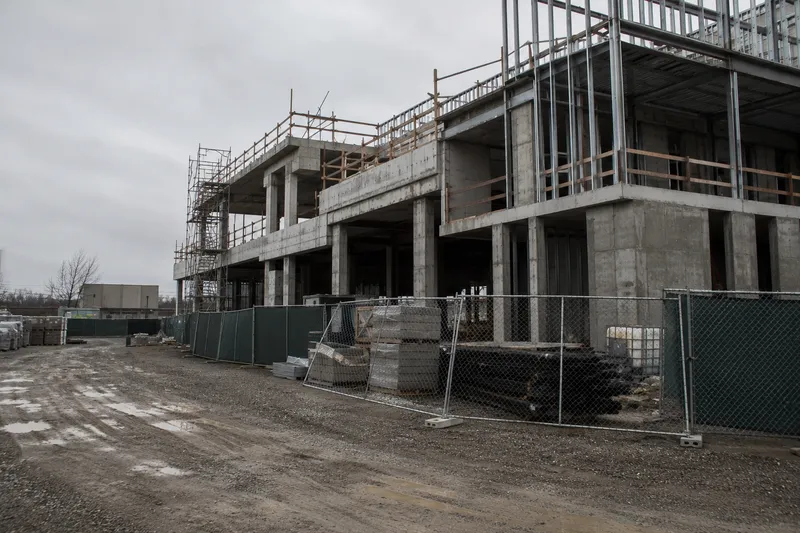
What walks off
The targets, roughly in programme order
What a site loses changes as it builds. Coverage that is designed once, at mobilisation, is aimed at the wrong things by fit-out.
Copper and cable
The classic target, and the exposure peaks during electrical rough-in when there is significant cable on site that has not yet disappeared behind walls. It is also the theft most likely to cause damage well beyond the value of what was taken.
Tools and small plant
Portable, valuable, trivially resaleable and rarely recovered. Losses here are continuous instead of dramatic, and they are usually absorbed by trades instead of reported — which means the site does not find out how bad it is until someone asks.
Fuel
Taken from plant, generators and bowsers, generally by people who know when the site is empty and where the plant is parked overnight. Fuel theft is the exposure most reduced by coverage of the compound rather than the perimeter.
Materials and finishes
Once fit-out starts, the site holds boxed appliances, fixtures and finished materials — the highest-value, most resaleable stock the project will ever hold, arriving exactly when the perimeter is most porous because deliveries are constant.
Plant and equipment
Larger items are taken less often but cost far more when they go, and they are usually removed through a gate instead of over a fence, which makes gate coverage the position that matters.
The programme itself
Not a target, but the actual loss. Replacing a stolen item is a purchase order; recovering a week of critical path is not, and no insurance line makes a delayed handover un-delayed.
Beyond theft
Trespass, vandalism and people who should not be on site
Theft is what gets budgeted for; trespass is what keeps site managers awake. An active construction site contains excavations, level changes, unguarded edges, stored plant and partially built structure, and it is hazardous to anyone who enters it without knowing what is where. That hazard does not distinguish between a thief, someone sheltering, and children who got through the fence.
This is a well-recognised exposure in the industry — insurers and courts have generally expected a site owner to take reasonable steps to secure a site that is inherently dangerous and foreseeably attractive to enter. What counts as reasonable in any particular case, and in your jurisdiction, is a question for your own counsel and your insurer, and this page is not the place for an answer to it. What we can say is the practical part: coverage that demonstrably detects and responds to entry is a materially different position from a fence and a sign.
- Detection at the boundary beats detection inside. The point of value is knowing somebody has entered, while they are still at the fence line and before they are standing next to an excavation.
- Vandalism and graffiti are recurring, not one-off. Sites that get tagged once get tagged repeatedly, and the cost is the remediation and the delay, not the damage itself.
- Occupation is the worst case. A site that becomes somewhere people stay is far harder to resolve than one that is entered and left, and it is almost always the result of an exposure that went unaddressed for weeks.
Progress, disputes and incident documentation
On larger projects this is frequently the value that outlives the build, and it costs little once cameras are on site anyway.
Progress record
A dated visual record supports reporting to owners and lenders, and it answers "what did the site look like in March" without anybody reconstructing it from memory or photographs on a phone.
Delay and sequence claims
When a delay claim is made, the argument is about what happened and when. Contemporaneous footage is a far stronger record than a reconstruction, and it is equally useful defending a claim or making one.
What is behind the wall
Coverage during rough-in records what was actually installed before it was covered up — useful at handover, and more useful the first time somebody has to open a wall to find out.
Safety incident documentation
Where an incident occurs, a record of the conditions and the sequence supports the investigation and the reporting that follows it.
Deliveries and site traffic
Gate coverage answers what arrived, when, and whether it left again.
Decide the purpose at design
Retention and coverage look different if the record has to be usable in a dispute a year after handover. That is worth settling at the start rather than discovering when somebody asks for footage that has aged out.
Compounds and gates
Controlling who gets in, and into what
A jobsite access problem is not really a perimeter problem — temporary fencing is a boundary marker and everyone treats it as one. The control that matters is on the things inside the fence that hold concentrated value: the site office, the container or store, the compound, and the gates that plant and deliveries move through.
- Site offices and containers. These hold tools, documents, equipment and often keys to everything else. Credentialed access with a record beats a padlock and a key that has been copied twice.
- Turnover is constant. Trades come and go weekly, so the ability to revoke access immediately, without recovering anything physical, is worth more here than on almost any permanent site.
- Gates are where plant leaves. Large items are taken through a gate, not over a fence. Coverage and control at the gate is what makes a gate log mean something.
- Deliveries need a route that works. Access control that obstructs deliveries gets propped open within a week.
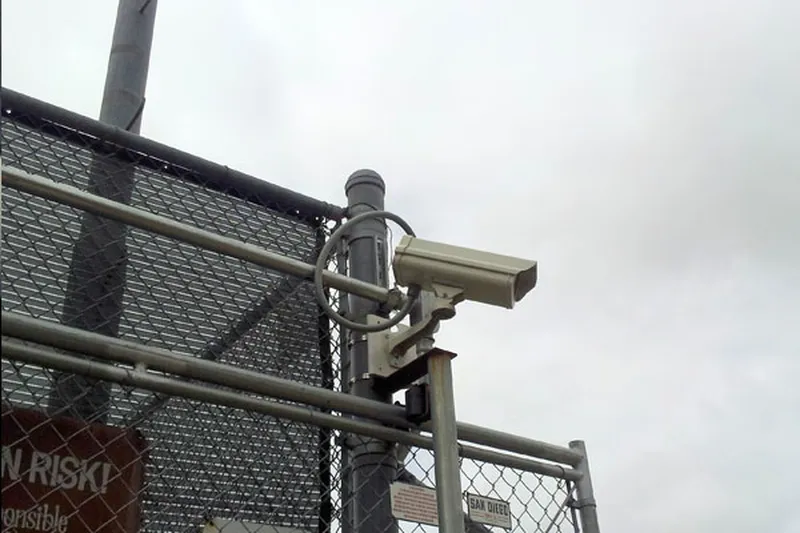
The shutdown window
After-hours monitoring, and why it fits jobsites so well
A recorded camera on an empty site produces a video of your copper leaving. Nobody is there to respond, and the loss is found the next morning along with the damage caused getting to it. That is the single most common failure mode in jobsite security, and it is not a failure of the camera — it is a failure of the model.
Remote video monitoring changes the model rather than the hardware. Operators watch the site's feeds live during shutdown hours, assess what they see, challenge over on-site speakers where the plan calls for it, and escalate to your contacts or to law enforcement. The event gets interrupted, not recorded.
Construction sites suit this better than almost any other environment, for reasons specific to how they operate:
- Shutdown is genuinely empty. Unlike an occupied property, there should be nobody on site at all outside working hours — so anyone present is worth looking at. Detection is far cleaner than on a site where legitimate activity continues around the clock.
- The window is defined and known. Coverage can be scoped precisely to the hours the site is closed, including the long holiday shutdowns when a site sits untouched for days and everyone locally knows it.
- Talk-down is unusually effective here. Most jobsite trespass is opportunistic and rests on the assumption that a fenced lot is unwatched at two in the morning. A live challenge naming what somebody is wearing and where they are standing disproves that on the spot, and much of it ends there.
- Silent escalation where a challenge is unsafe. On sites with excavations or live plant, startling somebody into running is the wrong outcome. That is a per-site decision in the response plan, not a default.
Where a site also carries intrusion detection on a compound, a container or a site office, pairing those activations with camera verification sits under commercial alarm monitoring so an alarm can be looked at before anyone is called out to it at three in the morning. Posted officers, where a site genuinely needs a person at the gate, are coordinated under BSIS PPO #121089, held by Guardian Integrated Security, Inc., of which we are a DBA — the same company under its other licence, and not provided by this brand.
A moving target
Coverage that moves with the build
A site that is an excavation, a site with a frame up and a site in fit-out are three different security problems. The valuable material is in a different place, the access routes are different, and the gate that made sense at mobilisation is frequently not the gate being used a year later.
- Review at phase changes, not on a calendar. The trigger is the programme — enclosure, rough-in start, fit-out, handover — because those are the points at which what is worth stealing moves.
- Reposition instead of replace. Positions that can be moved as the site changes are worth more over a programme than positions that were perfect once.
- Anticipate the moves already on the programme. The site plan for month eighteen exists. Designing against it is cheaper than reacting to it.
- Deliveries change the exposure. Fit-out means constant deliveries and a perimeter that is repeatedly open — the phase where the site holds the most and is hardest to close.
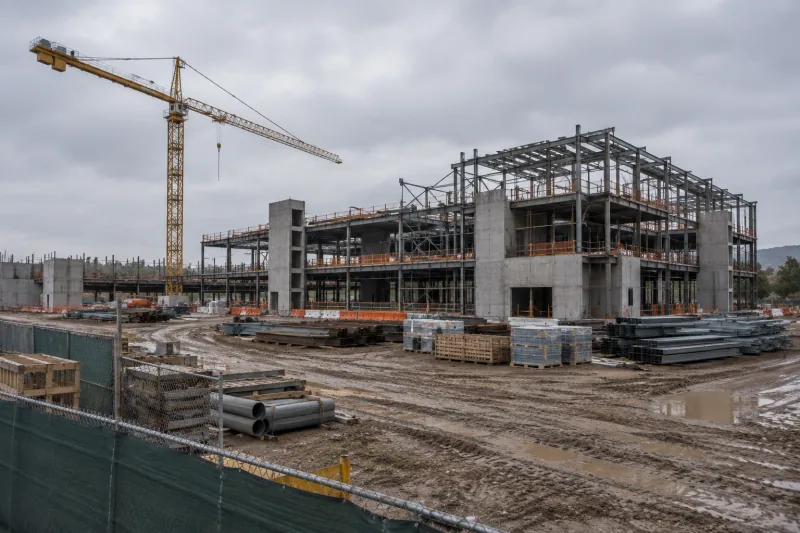
Handover
From temporary site security to the permanent building system
The most useful thing a contractor can do with jobsite security is decide at the start what happens to it at the end. Some of it is genuinely temporary and comes out. But the finished building needs a permanent camera system, permanent access control, and the cabling infrastructure underneath both — and the cheapest moment to install any of that is while the walls are still open.
- Design the permanent system during the build, not after it. Pathways, back-boxes, communications room locations and cable routes cost a fraction to install before closing up and a great deal to retrofit afterwards.
- The temporary arrangement scales down deliberately. Where the permanent system is planned, temporary coverage can be retired in stages as permanent coverage comes online, not switched off and replaced in one gap.
- Continuity of knowledge is worth money. A contractor on site since the ground broke already knows the building, the routes and what is behind which wall. That knowledge is normally lost at handover and paid for again by the next contractor.
The permanent camera system is covered under commercial security camera installation, and the infrastructure it runs on under structured cabling. Where a project takes over an existing building with a system already in it, that assessment runs under CCTV maintenance and repair. The full range of what we install is on the commercial services page, and the other verticals we build for are listed under industries.
Power and connectivity are the first design question
On a permanent building these are given. On a jobsite they are the constraint that decides what coverage is even possible, and they change as the programme advances. We design around what the site can support.
Power dictates the position
Where temporary power exists — a site office, a distribution board, a compound — it usually supports a practical arrangement nearby. Where a position has no power at all, the honest options are to work around it or to wait for a later phase.
Connectivity is normally cellular early on
Fixed line rarely arrives before the building does. What matters is the available upload capacity and how stable it is, because that decides whether a feed can be watched live or can only be recorded locally and reviewed later.
Self-powered positions are a design option
Solar and battery arrangements are a recognised way to cover a position with no supply, and where they suit a site they are scoped against that site's sun, season and the runtime the position actually needs — not assumed to work everywhere.
Local recording as the fallback
Where bandwidth cannot support live viewing, recording locally and retrieving on a schedule is a legitimate answer. It is an evidence system instead of a response system, and we will say which one you are buying.
Infrastructure improves as you build
Power and network get better every month of the programme, so a design can start lean and add coverage as the site gains the infrastructure to support it, not over-specifying at mobilisation.
It gets surveyed, not assumed
What a site can support is established by walking it. We will not price jobsite coverage off a site area over the phone.
Common questions
Construction site security questions
Almost every assumption a permanent install rests on is missing. There is no completed building envelope, so there is no perimeter in the usual sense — the fence line is the perimeter, and it moves. There is frequently no permanent power and no permanent network in the early phases. There is nobody on site for most of the hours when the site is exposed. The workforce changes weekly, so an access list is never static. And the whole thing is temporary by definition, which changes the economics: a permanent installation is hard to justify for a site that will not exist in eighteen months. The design has to be built around all of that, not in spite of it.
RelatedMobile surveillance units
The pattern is consistent across sites: anything portable, anything with resale value, and anything containing copper. Wire and cable are the classic target, particularly once electrical rough-in is under way and there is significant copper on site that has not yet been terminated behind walls. Tools and small plant walk off constantly and are rarely recovered. Fuel is taken from plant and from bowsers. Appliances, fixtures and finished materials become targets once fit-out starts, because at that stage the site holds boxed goods that are trivially resaleable. What matters commercially is usually not the replacement cost of the item — it is the programme delay when a trade cannot work on Monday.
RelatedMobile surveillance units
By designing around what the site can actually support at each phase, and being straight about the limits. Where temporary power is available at the site office or a distribution board, that frequently supports a practical camera and connectivity arrangement. Where a position has no power at all, the coverage plan either works around it or that area waits until a later phase — we would rather tell you an area cannot be covered properly yet than install something that produces unusable footage. Connectivity is normally cellular, not fixed line, at the early stages, and available upload capacity is what decides whether a feed can be watched live or only recorded locally. All of that is established by surveying the site — never assumed.
RelatedMobile surveillance units
It has to be revisited, which is not the same as reinstalled. A site that is a hole in the ground, a site with a frame up, and a site in fit-out are three different security problems with three different high-value areas — and the gate that made sense in phase one is often not the gate being used in phase three. The workable approach is a coverage plan reviewed at phase changes, with positions repositioned instead of replaced, and with the design anticipating the moves that are already on the programme. Sites that skip this end up with cameras pointed at whatever mattered nine months ago.
RelatedMobile surveillance units
For most sites, yes, and the reason is specific to construction. A recorded camera on a site with nobody present produces a video of your copper leaving. There is no one to respond, and the loss is discovered the next morning. Live monitoring puts an operator on the feed during shutdown hours, so there is an opportunity to interrupt the event — an audio challenge, then escalation to your contacts or to law enforcement. Jobsites are also unusually well suited to it: during shutdown there should be nobody on site at all, so anyone present is by definition worth looking at, which makes detection far cleaner than on a site that is occupied around the clock.
RelatedMobile surveillance units
It is more effective here than almost anywhere else. Most jobsite trespass is opportunistic, and the person on site is working on the assumption that nobody is watching a fenced lot at two in the morning. A live spoken challenge that describes what they are wearing and where they are standing disproves that assumption immediately, and a large share of it ends there without anyone attending. There are sites where a silent escalation is the better plan — where a challenge might send somebody running through an excavation or across live plant — and that is a decision made per site, not switched on by default.
RelatedMobile surveillance units
Not as our own service line, and this comes up on construction more than on any other kind of work. San Diego CCTV Pros is a licensed alarm and low voltage contractor — cameras, access control, alarm, monitoring and cabling. Posted officers and site patrols sit under the private patrol operator licence, BSIS PPO #121089, held by Guardian Integrated Security, Inc. San Diego CCTV Pros is a DBA of Guardian, so this is the same company working under its other licence instead of a subcontractor we hand you to — but patrol is Guardian's side of it, and we will not present it as something this brand provides. We would rather draw that line plainly at the first conversation than have it discovered when a site needs someone at the gate.
RelatedMobile surveillance units
Yes, and on larger projects that is frequently the value that survives the build. A dated visual record of the site is useful well beyond theft: it supports progress reporting to owners and lenders, it evidences sequence and timing when a delay claim is made, and it records what was actually in place before something was covered up. The same footage also supports safety incident documentation. It is worth deciding at design what the record is for, because retention and coverage look different if the record has to be usable in a dispute a year after handover.
RelatedMobile surveillance units
That is a design decision worth making at the start, not at handover. Some of what goes in during construction is genuinely temporary and comes out. But a completed building needs a permanent camera system, access control and the structured cabling underneath all of it — and a contractor who has been on the site since the ground broke already knows the building, the pathways and where everything runs. Planning the permanent system while the walls are still open is dramatically cheaper than retrofitting it after handover, and it means the temporary arrangement can be scaled down deliberately — not ripped out and started again.
RelatedMobile surveillance units
Yes — CSLB #976737, a C-7 low voltage contractor's licence, and BSIS ACO #7501 for alarm and monitoring. Both are on the state registers under Guardian Integrated Security, Inc., which is the name to search; San Diego CCTV Pros is a DBA of it. The licensing question that actually comes up on a jobsite is a different one: a temporary installation on a site with no permanent power still counts as low-voltage contracting work, and a general contractor asking whether their electrician can just put the cameras up is asking about a licence boundary rather than a preference.
RelatedMobile surveillance units