Multifamily & apartment
Apartment and multifamily security systems in San Diego
Built for the people accountable for the property — garages, parcel rooms, amenity access, credential turnover and the hours when no staff are on site. Common areas only, scoped around resident privacy.
Multifamily
You are accountable for a property you do not live in
Multifamily security is bought by people carrying a specific kind of exposure. A property manager, an owner-operator or an HOA board is responsible for shared spaces used by residents they cannot supervise, at hours when no staff are on site. That is a different brief from every other vertical here, because the system is not primarily there to catch a thief.
It is there to make shared spaces usable and defensible: to reduce the incidents that generate complaints, and to answer questions afterwards when somebody says the property failed to act. Garages and carports are where the incidents concentrate, where the complaints originate, and where camera work is hardest to do well — a single camera hung at the wrong height answers neither of the two questions that get asked. Vehicle-level coverage tells you which car and which plate. Pedestrian-level coverage tells you who the person was. They are different positions.
Parcel rooms are the other reliable source of friction, and the volume only goes one way. Access control on a property with continuous resident turnover is less about hardware than about whether credentials can be revoked quickly and reliably when somebody moves out, because on most properties that is where control quietly leaks away.
Common areas only, scoped around resident privacy. Audio in particular raises obligations that video alone does not, and we will set out where that line sits before it becomes a problem.
That is with us. We will come back to arrange a survey. If it is urgent, call (858) 222-7547.
- CSLB C-7 #976737
- BSIS ACO #7501
- CMMC certified
- SAM.gov registered
- Est. 2008
The operator's problem
You are accountable for a property you do not live in
Multifamily security is bought by people carrying a specific kind of exposure. A property manager, an owner-operator or an HOA board is responsible for shared spaces used by residents they did not select, at hours when nobody is on site, and is answerable afterwards — to owners, to insurers, to counsel and to residents at the next meeting — for what happened and for what the property did about it.
That produces a different brief from any other vertical on this site. The system is not primarily there to catch a thief. It is there to make shared spaces usable and defensible: to reduce the number of incidents that happen at all, to produce a reliable record when one does, and to demonstrate that the property took reasonable steps. A camera that records a garage assault in unusable quality has failed at all three, and the failure surfaces in a claim or a complaint, not on a monitor.
The pressures that actually drive these purchases are consistent:
- Common-area duty of care. Garages, corridors, laundry rooms, amenity spaces and gates are yours to keep in reasonable condition, including whether they are lit and observable.
- Documentation for claims and counsel. When an incident becomes a claim, the question is what footage exists, whether it is retrievable, and whether it shows anything identifiable.
- Resident experience and retention. A garage residents avoid at night, or a parcel room where deliveries disappear, becomes a leasing problem long before it becomes a security problem.
- Continuous turnover. Residents, staff and vendors change constantly, and every one of them holds some form of access.
- No staff after hours. Most properties are unstaffed exactly when the exposure is highest.
- Privacy expectations. People live here. Coverage that would be uncontroversial in a warehouse is not acceptable in a residential corridor.
What follows maps each of those to how the work is actually scoped.
Common areas
Vandalism, trespassing and loitering
The persistent nuisance problems on residential property are rarely dramatic and are disproportionately what residents actually complain about: tagging in stairwells and garages, non-residents in amenity spaces, people sleeping in laundry rooms or refuse enclosures, and gates propped open often enough that they stop functioning as gates.
- Access control does more than cameras here. Most of these problems are non-residents in resident-only space, and the fix is a door that works and a credential that is required, not another camera watching it happen.
- Cover the approach, not just the space. Footage of somebody already inside a stairwell is less useful than footage of the point they entered at, where they are facing the camera and identifiable.
- Repeat problems need pattern, not incidents. A system that lets staff search a location across a week is what turns scattered complaints into an identified pattern and a specific fix.
- Refuse enclosures earn their coverage. Dumping by non-residents is a real cost, and enclosures are almost always outside the original camera schedule.
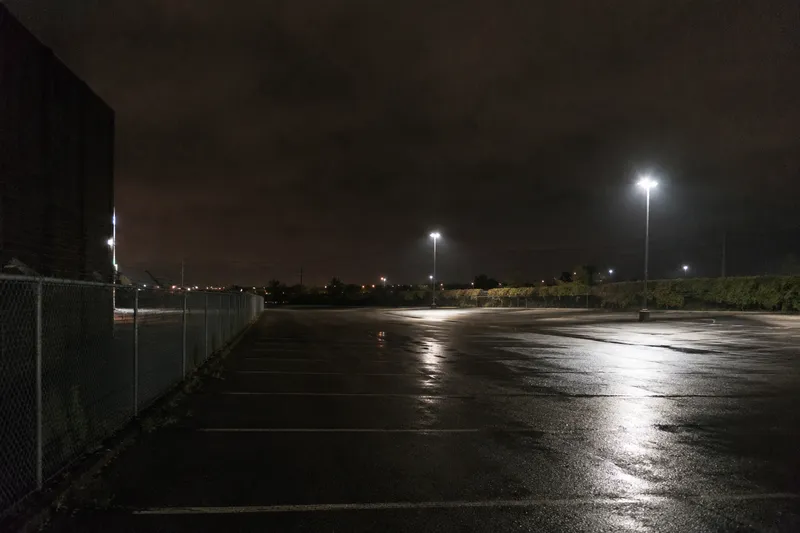
Highest-incident area
Parking structures and carports
On most properties this is where the incidents concentrate, where the complaints originate, and where the camera work is hardest to do well. It is also where a limited budget produces the most benefit.
Two heights, two problems
Vehicle-level coverage answers which car and which plate. Pedestrian-level coverage answers who the person was. These are different positions and different lenses, and a single camera hung in the middle usually does neither well enough to be useful.
Concrete decides the sightlines
Columns, ramps and low ceilings break coverage that looked continuous on a floor plan. Garage design is done by walking the structure, not by drawing on the drawing, because the dead zones are only obvious in place.
The entry ramp is a backlight problem
A camera facing a ramp mouth in daylight sees a silhouette, and at night it sees headlights. Positions covering the transition need the dynamic range to handle it, or they return footage of a bright rectangle.
Lighting is part of the system
Coverage and illumination are the same conversation. A garage that is unpleasant to walk through at night is both a security condition and a resident-experience one, and no camera specification compensates for a structure nobody wants to enter.
Gates are their own scope
Vehicle gates fail in ways pedestrian doors do not — tailgating vehicles, propped or damaged gates, and residents who share remotes. Camera coverage at the gate is what turns a gate log into evidence of who came through.
Bicycle and storage areas
Cages and storage rooms attached to garages hold significant resident property and are frequently the least covered space on the site, because they were not on the original camera schedule. Where losses here are persistent, live monitoring during the overnight hours is usually more effective than more cameras.
Parcels
Mail rooms, parcel rooms and the delivery problem
Package loss is the complaint multifamily operators hear most often, and it is the one most frequently addressed with the wrong tool. A camera in a parcel room documents a loss; it rarely prevents one, and residents who are told that footage exists but nothing can be done are not reassured by the camera.
The arrangement that works is access control on the room first, camera second. A credentialed door limits the room to residents and to carriers you have deliberately authorised, and it produces a record of every entry. The camera then belongs at the threshold, framed to capture an identifiable face at the point of entry — not mounted high in a corner recording an overhead view of shelving.
- Carrier access is the design question. Deliveries happen whether or not the room is convenient, and a room that is hard for carriers to use ends up propped open — which defeats the credential entirely. Solve for how carriers actually work.
- Threshold coverage over room coverage. One well-placed camera at the door at face height is worth several looking down at a room.
- Access records make footage searchable. Pairing a door event with the corresponding camera view turns "sometime last week" into a timestamp, which is the difference between reviewable and unreviewable footage.
- Locker systems change the scope, not the need. Where a property installs parcel lockers, the room still needs coverage of the approach and the lockers themselves.
The door hardware, readers and credential side of this is covered under commercial access control, and the camera positions under commercial security camera installation.
Access control on a property that never stops changing
Multifamily has continuous churn — residents, staff, vendors and guests — and every one of them holds access of some kind. This is the operational pain that most reliably justifies moving off mechanical keys.
- Revocation is the whole argument. A lost key is dealt with by rekeying a cylinder, and on a master-keyed building that can cascade. A lost fob is revoked in software in seconds, with a record of when. On a property with constant move-outs, that difference compounds every month.
- Fobs and mobile credentials together. Fobs are simple and counter-issuable but get shared and lost. Mobile credentials are issued and revoked remotely, which suits after-hours move-ins. The system should support both so a change of preference is not a re-badging project.
- Amenity spaces have their own rules. Pools, gyms and clubhouses need hours, not just permissions — access that opens and closes on a schedule, with after-hours entry either barred or logged, because unsupervised amenity access is a liability question as much as a security one.
- Vendors and staff are credentials too. Landscapers, cleaners, maintenance contractors and leasing staff all hold access, and vendor credentials are the ones most likely to outlive the relationship because nobody owns the offboarding.
- Tailgating is a records problem. A reader event proves a door opened, not who walked through it. Camera coverage of controlled doors is what converts an access log into something you can rely on afterwards.
- Egress is never negotiable. Residents must be able to leave whether or not the system has power. That is designed in from the start, and any interface to the fire system is coordinated with your fire alarm contractor.
- Deterrence comes from the property looking maintained. Working lights, gates that latch, and cameras that are evidently live and evidently new do more together than any one of them alone.
Apartment remote video monitoring, in place of a patrol
Most properties are unstaffed overnight and across weekends, which is exactly when the garage, the gates and the amenity areas carry the most exposure. The traditional answer is a courtesy patrol. The alternative more operators are now buying is apartment remote video monitoring — trained operators watching the property's existing camera feeds live, off site, during the hours nobody is there.
Multi-family residential remote video monitoring differs from the industrial version in one important respect, and getting it wrong causes complaints:
- The property is occupied around the clock. Unlike a yard or a warehouse, there is no hour when everyone present is an intruder. Detection has to be scoped to areas and behaviours, not to presence, or the operator spends the night watching residents come home.
- Notification usually beats audio challenge. A broadcast talk-down across a courtyard at night reaches residents in bed. On most residential properties the response plan favours contacting your people, and law enforcement where warranted, over a spoken challenge.
- Scope it to specific areas. Whole-site coverage is the wrong instinct here. Garages, gates, parcel and mail areas, amenity spaces after hours and refuse enclosures carry nearly all of the value.
- It runs on the cameras you have. Where the existing system can present a usable live view, monitoring is a layer on top.
The service itself, including how operators assess and escalate, is covered under remote video monitoring. Where a property also carries intrusion alarms on amenity or plant rooms, pairing those with camera verification sits under commercial alarm monitoring so an activation can be looked at before anyone is called out to it. Posted officers, where a property genuinely needs a physical presence, are coordinated with a licensed guard operation, not provided by us.
Coverage geometry, not cost alone
A patrol has a route, and therefore a period
Anybody observing the property for a week learns roughly what that period is. An operator holds the garage, the gate, the parcel room approach and the pool deck at the same moment.
Attention does not degrade across a long quiet shift the way it does for a person walking a site at three in the morning.
Whether it replaces the patrol you pay for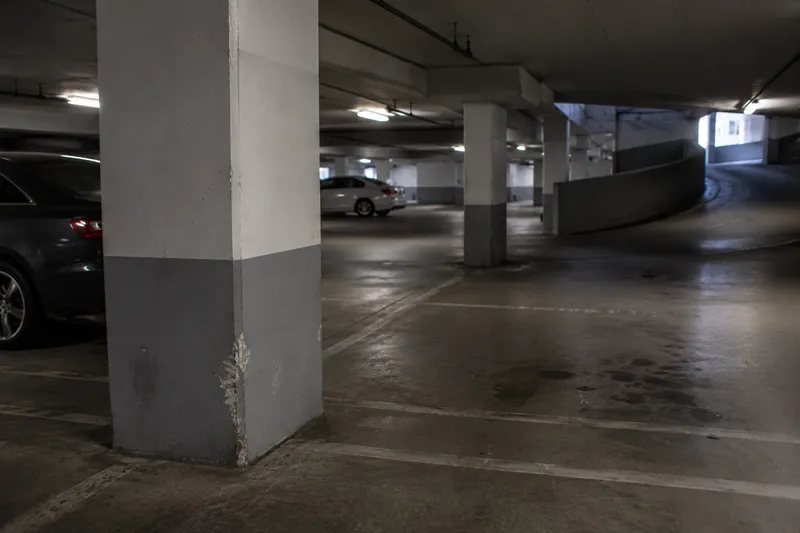
Privacy
Resident privacy, and the audio question
People live here, which makes coverage decisions different in kind from any commercial site. The working rule on our designs is common areas and shared infrastructure only, and the exclusions are treated as part of the specification, not as an afterthought at commissioning.
- Never inside a residence. No exceptions, and no camera positioned so that a unit interior is visible when a door or window is open.
- Not aimed at individual unit doors. A corridor camera covers the corridor. A camera that effectively monitors one household's comings and goings is a different thing, and it is not what we install.
- Field of view trimmed on site. Patios, balconies and windows are excluded by adjusting the position and the lens at commissioning, not by promising it in a proposal.
- Signage and disclosure. Residents being aware that common areas are covered is both ordinary practice and part of how the system deters anything.
- Access to footage is controlled. Who can view and who can export should be a defined, logged function. On a residential property the recorded material is sensitive in its own right.
- Retention set by policy. Decided deliberately with your counsel and insurer. Whatever the recorder's disk happens to allow.
Audio is a separate question from video, and a more constrained one. Under California Penal Code § 632, intentionally using a recording device to record a "confidential communication" without the consent of all parties is prohibited. The statute defines a confidential communication as one carried on in circumstances that may reasonably indicate a party desires it to be confined to the parties — and it expressly excludes circumstances in which the parties may reasonably expect that the communication may be overheard or recorded. That exception is why this is fact-dependent: whether a particular lobby, corridor, garage or amenity room falls inside or outside the definition turns on the circumstances of that space, and it is not a determination we make on your behalf. Statute text verified as of 25 August 2026.
What we do about it
Video-only by default, not because the hardware cannot
We scope audio conservatively and design video-only in shared residential spaces by default. We don’t enable microphones just because the hardware supports them.
None of the above is legal advice, and we are not the right people to give it. If you want audio anywhere on the property, take the question to your counsel first and we will design to whatever position they set.
Where audio is the point of the device
Older stock
Retrofitting a property that was not built for this
Most multifamily work in San Diego County is retrofit, not new construction, and the cabling is what shapes the design. An older garden complex has limited pathways, occupied units that cannot be routed through, garage structures where every penetration is a decision, and frequently a layer of legacy coax and undocumented cable from previous contractors.
- The survey is the quote. Cost on these properties is decided by pathway and distance, not by camera count, which is why we will not price a property off a unit count over the phone.
- Distance limits drive the layout. Copper has a hard limit, so spread-out properties need intermediate communications rooms or fiber between buildings — and separately grounded structures are a reason for fiber regardless.
- Existing cable is assessed, not assumed. Some legacy coax is perfectly serviceable and can carry an IP system over an adapter. Some of it is the reason the system cannot be upgraded. We will tell you which you have.
- Work happens around residents. Occupied buildings change the sequence, not the standard: staged cutovers, work scheduled around quiet hours, and no abandoned cable left in ceilings.
- Wireless is a considered exception. Where a pathway genuinely does not exist, a wireless link is a legitimate answer for a specific run — not a way to avoid surveying the building.
Running several properties as one system
Where a management company holds multiple communities, the gains from standardising are mostly administrative — and they are the gains that make a system usable by the people who actually have to use it.
- One platform, one way of working. A regional manager covering a site they do not normally work at can find footage without being talked through it, and staff moving between properties do not relearn a system each time.
- Consistent conventions. The same camera naming, the same credential scheme and the same retention settings across sites. Inconsistency is what makes portfolio-wide questions unanswerable.
- Permissions that match the org chart. Site staff see their site; regional staff see their region. That is an administrative decision the platform should express. A spreadsheet of logins nobody maintains.
- Comparable reporting. Incident and access reporting that reads the same across the portfolio lets an owner see which properties actually have a problem. The alternative is seeing which have a manager who reports diligently.
- Procurement gets simpler. One equipment standard means predictable specification, spares that interchange, and staff training that carries between sites.
- Each property is still surveyed. What standardises is the platform and the conventions — not the camera schedule. A 1970s garden complex and a new podium building do not get the same design because they share an owner.
The infrastructure work is covered under structured cabling, and where a property already has a system worth assessing, not replacing, that survey runs under CCTV maintenance and repair. The full range of what we install is on the commercial services page, and the other verticals we build for are listed under industries.
Common questions
Multifamily and apartment security questions
The working principle is common areas and shared infrastructure only — entrances and lobbies, parking structures and carports, mail and parcel rooms, amenity spaces, refuse enclosures, gates and perimeter approaches. Cameras are not pointed at unit doors in a way that monitors a particular household, not into windows, patios or balconies, and never inside a residence. On a well-designed system the exclusions are as deliberate as the coverage: field of view is trimmed at commissioning so a camera covering a corridor does not incidentally frame the inside of a doorway when a resident opens it. Where a position cannot be aimed to cover the shared space without capturing private space, the answer is to move the camera or change the lens, not to accept it.
Because they concentrate everything that goes wrong. A garage holds high-value property belonging to residents and their guests, it is accessible to more people than any other part of the site, it is poorly lit by construction, and it is the area residents are most often alone in and most often complain about. It is also the hardest environment to get right: concrete blocks sightlines, ramps and columns create dead zones, headlights and daylight at the entry ramp produce backlight that flattens a face into a silhouette, and vehicle-level and pedestrian-level coverage are two different camera positions, not one. A property that only funds one phase of work usually gets the most out of spending it here.
Access control on the room does more than the camera does, and the two together do more than either alone. A camera in a parcel room documents a loss after it has happened; a credentialed door means only residents and the carriers you have authorised get in, and it produces a record of who did. The camera then earns its place at the threshold, not the ceiling — positioned to capture identifiable faces at the point of entry. What consistently fails is a camera mounted high in a corner and a door propped open for deliveries — which is the arrangement most properties actually have.
On a credential-based system, nothing you need to worry about: the credential is revoked in software, immediately, and the record shows when. That is the entire operational argument for moving off mechanical keys on a multifamily property. A key that leaves the building can only be dealt with by rekeying the cylinder, and in a building on a master key system rekeying one door can mean rekeying far more than one. Multifamily has continuous turnover, so a property using keys is either rekeying constantly or, far more commonly, quietly accepting that it does not know how many keys to its common doors are in circulation.
Usually both, chosen against how the property actually operates — not as a philosophical choice. Fobs are simple, work without a phone or a battery, and are easy to issue at a leasing office counter — but they get shared and they get lost. Mobile credentials are issued and revoked remotely, which suits high-turnover properties and out-of-hours move-ins, and they are harder to hand to somebody else casually. What matters more than the choice is that the system supports both, so you are not re-badging the entire property when the preference changes, and that revocation is genuinely immediate on either.
Often, yes, and that is the most common reason multifamily operators look at remote video monitoring. A patrol has a route and a period, and anybody watching the property for a week learns both; monitored cameras hold the garage, the gates and the amenity areas simultaneously and do not have gaps in that sense. Operators watch the feeds live during the hours the property has no staff, assess what they see, and escalate along a plan you agree in advance. On an occupied residential property the response plan usually favours notifying your contacts and, where warranted, law enforcement. A broadcast audio challenge across a courtyard at night is the alternative it avoids — that reaches residents too.
We scope audio conservatively and default to video-only in shared residential spaces. The reason is that audio sits under a different body of California law from video. Under California Penal Code § 632, intentionally recording a "confidential communication" without the consent of all parties is prohibited, and the statute defines a confidential communication as one carried on in circumstances that may reasonably indicate a party desires it to be confined to the parties — while expressly excluding circumstances in which the parties may reasonably expect the communication may be overheard or recorded. Whether any particular lobby, corridor or garage falls inside or outside that definition depends on the facts of the space, and it is not a determination we make for you. Statute text verified as of 25 August 2026. This is not legal advice — if you want audio anywhere on the property, take it to your counsel first, and we will design to whatever they tell you.
Yes, and the gains are mostly operational, not technical. One platform across the portfolio means one way of pulling footage, one credential scheme, one naming convention and one set of permissions — so a regional manager covering a site they do not normally work at can still find what they need, and staff moving between properties do not have to relearn a system. It also makes reporting comparable across sites. The infrastructure at each property still gets designed for that property; what standardises is the platform, the conventions and the administration, not the camera schedule.
It is usually the constraint that shapes the whole design, and it is the reason a survey matters more here than on new construction. Older residential buildings have limited pathways, occupied units you cannot route through, garages with concrete you cannot simply drill, and often a mix of legacy coax and cabling nobody has documentation for. That does not make the work harder to do well — it makes it harder to quote honestly without looking first, which is why we will not price a property off a unit count over the phone. Where existing cable is serviceable we will tell you, and where it has become the reason the system cannot be upgraded we will tell you that too.
Licensed yes, patrol no, and the two are easy to conflate on a residential property. The install work — lobby and garage cameras, the cabling, the door stations — is C-7 low voltage work under CSLB #976737. The monitored CCTV, the intrusion alarm and the credentials on amenity and package rooms are Alarm Company Operator work under BSIS ACO #7501. Both are issued to San Diego CCTV Pros and both sit on the public register. Fire alarm is outside both: that needs a C-10 or a C-16, we hold neither, and on a building with interlinked corridor doors it stays with your own licensed fire alarm contractor. Courtesy patrol and posted officers are not our service line. They sit under the private patrol operator licence, BSIS PPO #121089, held by Guardian Integrated Security, Inc. — and San Diego CCTV Pros is a DBA of Guardian, so that is the same company under its other licence, not an outside firm. Patrol is Guardian's side of the business; we coordinate it and do not sell it under this brand. We work on commercial premises only, which includes managed residential property but not private homes.