Commercial remote video monitoring
Remote video monitoring for San Diego commercial sites
Trained operators watching your camera feeds live, off site, and acting on what they see while it is still happening — audio challenge, verified escalation, and cover for the hours nobody is standing on the property. Licensed under BSIS ACO #7501, and built on the cameras you already own wherever they are good enough to act on.
Remote Monitoring
Most sites already have cameras. Far fewer have anyone watching them
Those are two different products and they solve two different problems, which is why a site that buys one expecting the other is disappointed for predictable reasons. A recorder answers questions afterwards. Live monitoring is an attempt to interrupt something while it is still happening. If what you actually want is for somebody to intervene at two in the morning, a recording will never do it however good the picture is.
The mechanism is straightforward once the vocabulary is stripped out. Detection happens at the site — analytics on the camera or recorder distinguishing a person or a vehicle from a branch moving in the wind — and raises an event. An operator off site sees it, assesses it, and acts: an audio challenge over a speaker, a call to your list, a verified escalation. Nothing in that sequence needs a person standing on the property, which is how one operator can hold several positions across a large yard, or several separate properties.
It usually runs on the cameras you already have, so the first question at survey is whether your existing positions can carry it. Some can. Positions installed to record a scene after the fact are not always aimed or lit for a decision made in real time, and we will say which of yours are which rather than selling a service over cameras that cannot support it.
Audio talk-down is powerful and is not always the right response — there are sites and situations where announcing that somebody is watching is the wrong move.
That is with us. We will come back to arrange a survey. If it is urgent, call (858) 222-7547.
- CSLB C-7 #976737
- BSIS ACO #7501
- CMMC certified
- SAM.gov registered
- Est. 2008
The explainer
What is remote video monitoring?
Remote video monitoring is a service in which trained operators watch a commercial site's camera feeds live, from off site, and act on what they see while it is happening. It is also sold as live video monitoring, as virtual guarding, as remote guarding, and as a virtual security guard service. Those are five names for one thing, and the thing itself is the difference between a camera that records an incident and a camera that interrupts one.
The mechanism is straightforward once the vocabulary is stripped out. Detection happens at the site — analytics running on the camera or the recorder that distinguish a person or a vehicle from the wind, the rain, a cat and a set of headlights sweeping a wall. When something crosses a line you have defined, or enters an area at an hour it should not, that event pushes a live view to an operator. The operator assesses it, classifies it, and follows a response plan you agreed in writing before the service started.
The whole commercial argument
A patrol route has a period. A camera position does not.
Nothing in that sequence requires a person on the property. A single operator can hold several camera positions across a large yard, or several separate properties, in a way somebody walking a patrol route cannot — because the route has a period, and the intruder only has to know roughly what it is.
What it is not is a recording system with a nicer app. Recorded review and live monitoring answer different questions, and a site that buys one expecting the other is disappointed for predictable reasons.
Whether it replaces the guard you are paying for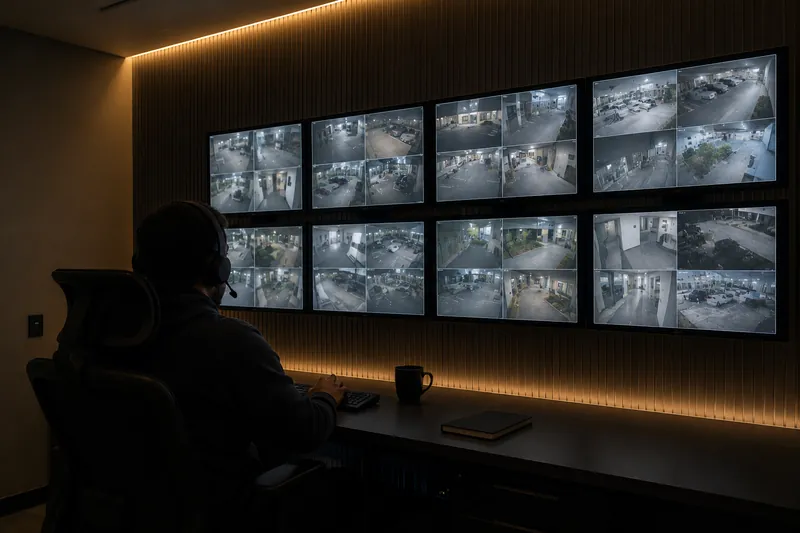
The distinction that decides everything
Live monitoring versus recorded review
Recorded review answers "what happened"
A recording system is an evidence system. It tells you afterwards who came through the gate, in what vehicle, and what left with them. That matters — for the insurance claim, for the police report, for the employment case — but it does all of it after the loss has occurred and the vehicle has gone. Its value is retrospective by design.
Live monitoring answers "what is happening"
A monitored system is event-driven. The analytic detects, an operator sees it live, and there is a window — often a short one, but a real one — in which the event can be interrupted before anything is taken or damaged. The camera stops being a witness and becomes part of the response.
Attention is the scarce resource
Nobody watches a wall of screens for a whole shift and sees everything on it; that is a fact about human attention. Event-driven monitoring inverts the problem — the operator is not asked to notice something in a quiet frame, they are handed a frame that has already been flagged.
Both, usually
This is not an argument against recording. Monitored sites still record, because the evidence requirement does not go away and the retention policy still has to be met. Monitoring is a layer on top of recording, not a replacement for it.
The unwatched recorder problem
An unmonitored recorder that has been offline for a fortnight looks exactly like an unmonitored recorder that is working. Sites discover this on the one day it matters. A monitored connection that stops reporting is itself an event, and gets treated as one.
Detection quality sets the ceiling
A feed that alarms on every passing car and every branch trains everyone who sees it to ignore it. Getting detection right — camera aim, analytic zones, lighting, and what counts as an event at which hours — is the difference between a service that works and a service that generates noise.
The response plan
What happens when an operator sees something
The escalation path is agreed with you in writing before the service begins, and it is followed — never improvised. This matters more than any feature on a specification sheet: at two in the morning, the question of who gets called and in what order should already have been answered.
- Detect. An analytic at the site flags activity — a person crossing a perimeter line, a vehicle entering a yard, movement in an area that should be empty at that hour — and pushes the live view to an operator.
- Assess. The operator looks at what is actually there. A great deal of what a camera flags at night is legitimate: your own staff, a scheduled delivery, a contractor with site access, a tenant. Those are logged and closed, and the log is yours.
- Challenge. Where the activity is not legitimate and the site's plan calls for it, the operator speaks through the on-site speakers — describing the person, where they are standing, and what they are doing.
- Notify. Your named contacts are called in the order you set, with the detail the operator can see. Who is on that list, and at which hours, is your decision, and it is reviewed.
- Escalate. Where what the operator is watching justifies it, law enforcement is called. Because the operator is describing an offence in progress that they can see and narrate, that call carries information a bell-only alarm activation does not.
- Document. The event, the footage and the actions taken are recorded, so there is an account afterwards.
We do not publish response times, and you should be cautious of anyone who does without saying how they measured them. What we will do is agree the plan with you, in writing, and tell you plainly what the service does and does not undertake to do.
Deterrence
Audio talk-down, and when not to use it
Why it works
The effect comes from being specific and evidently live. A person who has just been described by their own clothing and told which corner of the yard they are standing in understands immediately that they are being watched by someone, not by a recording. Their working assumption — that the site is unobserved — has just been disproved, and a large share of opportunistic trespass ends there.
Why a recorded message does not
A generic looped announcement triggered by motion teaches the opposite lesson. It is obviously automated, it plays for cats and delivery drivers alike, and after the second visit an intruder has learned that nothing follows it. Automated audio is a sign; live audio is a person.
Speaker placement is the install
Talk-down only works where the challenge is audible and intelligible at the position the intruder is actually standing. That is a design and installation question — horn placement, coverage of the approach routes, and enough level over ambient plant and traffic noise — and it is done under the same C-7 scope as the cameras.
Where it is the wrong response
On an occupied multi-family property, a broadcast challenge across a courtyard at night reaches residents as well as the subject. On some industrial sites the safer plan is silent escalation, so that a subject who is stealing copper is not startled into running through live plant. The response plan chooses per site and per area, not once for everything.
Neighbours and nuisance
Audio carries further at night than the person specifying it expects. Where a yard backs onto residential property, the plan accounts for that — both because it is the neighbourly thing and because a complaint is the fastest route to a system being switched off.
California recording law
Talk-down is an outbound announcement, which is a different legal question from recording conversation. Audio capture is constrained in California in ways video is not, and we scope camera audio conservatively. Enabling microphones because a product supports them.
Qualifying the site
What makes a site a good fit
Remote video monitoring is not right for every commercial property, and we would rather establish that at survey than sell a service that disappoints. The sites where it works share most of these characteristics:
- A definable perimeter or a small number of approach routes. Detection needs somewhere to draw the line. A site with one fence line and two gates is straightforward; an open frontage on a busy street is harder and needs the analytic scoped tightly to avoid alarming on the pavement.
- Long periods when nobody legitimate is present. The clearer the distinction between "should be empty" and "in use", the cleaner the detection and the fewer events that are nothing.
- Enough light, or cameras that do not need it. Detection at night is where most monitoring propositions quietly fail. Either the site has usable lighting, or the positions that matter have imaging that works without it.
- An internet connection that stays up. Not a fast one necessarily, but a stable one, with enough upload to carry a live view when it is needed.
- Something worth stealing, or somewhere worth not being. Plant, metal, fuel, vehicles, stock — or a building whose occupation by someone else is itself the loss.
- Someone to escalate to. A response plan needs names and numbers that answer. Monitoring with no reachable contact and no police-worthy threshold is an expensive log file.
If a site does not fit that description, the useful conversation is usually about the camera system itself — coverage aimed wrongly, night performance that is not good enough, or a recorder that has been failing quietly. We will tell you when that is the actual problem. Layering a monthly service on top of it. Either way the start is the same: a survey of the actual site, a written account of what the existing system can and cannot support, and a response plan agreed before anything is switched on. Commercial premises only, not private residences.
Monitoring runs on the cameras you already have
The usual starting point is an existing system, not a new one. Most commercial sites that ask about a remote video monitoring service already own cameras — the gap is that nobody is watching them at three in the morning, which is precisely when the cameras earn their keep.
Where the footage lives, and what happens to recording when the link drops, is a separate decision with its own trade-offs — see cloud versus on-premise video management. Whether an existing system can be monitored comes down to three practical questions, and they are answered at survey, not assumed:
- Can it present a live stream off site? The recorder or the cameras have to be able to hand a live view to an operator reliably, not merely expose an app to you.
- Will the connection carry it? Upload bandwidth, stability and how the site behaves at night decide whether an operator sees a usable image or a slideshow.
- Is the detection good enough to act on? Analytics have to separate a person from a moving tree in the dark. Where they cannot, the result is either noise everyone learns to ignore or genuine events nobody sees.
Where a system falls short, it is usually for reasons that have nothing to do with the monitoring service. Cameras aimed for evidence rather than detection, a position whose night image collapses at the range that matters, PoE or cabling faults causing dropouts — these are conditions on the existing system, and they get fixed as their own piece of work under CCTV maintenance and repair rather than papered over. Where a site needs new coverage or new positions before monitoring is worth buying, that sits under commercial security camera installation.
The advantage of the same licensed contractor doing both is narrow but real: when a monitored feed degrades, nobody is left arguing about whether it is the monitoring service's problem or the installer's. The camera work is C-7 scope; the monitoring is ACO #7501 scope; both are ours, and the fault is diagnosed, not allocated.
Alarm verification and access control
Remote monitoring is most useful when it is not a standalone product. The camera system, the intrusion alarm and the doors are describing the same building, and an operator who can see all three has context that none of them provides alone.
Video-verified alarm response
An intrusion activation on its own is an assertion that something happened. Paired with a camera view of the same zone, it becomes an observation: an operator can see whether a door contact tripped because of a break-in or because the wind caught a roller shutter. That pairing is set up with commercial alarm monitoring.
Fewer false activations reaching you
The practical benefit of verification is that activations which can be resolved on camera are resolved on camera, not becoming a call-out for whoever is on the key-holder list. That is a quality of life change for whoever currently drives to the site at night. The scale of what verification filters is on false alarm statistics for San Diego: in 2025, 90 of 17,075 dispatched burglary alarm calls ended in a report or an arrest.
Doors as context
An access system knows which credential opened which door and when. An operator watching the corresponding camera can see whether the person who walked through matches the credential that opened it — which is how tailgating and shared-card use actually get caught. See commercial access control.
One survey, one contractor
Cameras, doors, intrusion and the cabling underneath all get surveyed in the same visit, under the same two licences. The infrastructure they share is covered under structured cabling.
Remote unlock, carefully scoped
Where a plan calls for it, an operator who can see a caller at a gate or a door can grant access to an expected delivery or a maintenance visit out of hours. This is deliberately narrow in scope, logged, and agreed in advance — a convenience with a clear audit trail, not an open door.
Where our scope ends
The monitoring itself is performed under BSIS ACO #7501 and the camera, cabling and access work under CSLB C-7. We do not hold a C-10 or a C-16, so fire alarm work is coordinated with your licensed fire alarm contractor and not performed or monitored by us. A physical guard response sits under a different licence again — the private patrol operator licence, BSIS PPO #121089, which is held by Guardian Integrated Security, Inc. San Diego CCTV Pros is a DBA of Guardian, so that is the same company under a different licence, and posted guards are Guardian's lane: we coordinate them and do not sell them under this brand. Both boundaries are stated at design, not discovered during an incident.
After hours, weekends, and sites nobody is standing on
Commercial intrusion is a scheduling problem before it is a security problem. The risk concentrates in the hours when a site is empty and predictable — overnight, weekends, and the long holiday closures when a yard sits untouched for days and everyone local knows it.
That is why monitoring is usually bought as a schedule, not as an always-on service. A distribution facility running two shifts does not need an operator watching the dock at eleven in the morning; it needs one from the moment the second shift clears until the first arrives, and across the whole weekend. Getting that schedule right is most of the value, because it puts the coverage where the exposure is. Spreading it evenly across a week that is not evenly risky.
Two categories of site are exposed in a way that is worth calling out separately, because for both of them a camera that only records is close to useless:
- Construction sites. High-value plant, an incomplete perimeter, no permanent power in the early phases and a workforce that changes weekly — and, by definition, temporary, which makes a permanent installation hard to justify and redeployable monitored coverage a better fit. Copper, fuel and tooling leave these sites overnight, and the theft is usually the smaller half of the loss once programme delay is counted.
- Unoccupied and part-tenanted property. A building between tenants has nobody to notice a forced door, and the damage from a squat or a stripped copper riser is found days later by whoever next opens up. It is also where an unmonitored recorder is most likely to have failed quietly, because nobody is on site to notice.
Seasonal cover is a normal way to buy this. A yard that shuts over the holidays, a facility mid-fit-out, a property waiting on a sale — these are finite exposures, and monitoring can be scoped to them. Sold as a permanent contract nobody revisits.
Where remote video monitoring earns its place
The service is the same; what changes by sector is what counts as an event, which areas matter, and what the response plan should do about it.
Industrial and manufacturing
Industrial remote video monitoring generally covers a yard, a perimeter and a set of external plant positions. The exposures are metal, fuel, tooling and vehicles, and the sites are frequently large enough that a perimeter is long relative to the number of people available to watch it. Where a site has live plant, the response plan usually favours silent escalation over an audio challenge that might send someone running through it.
Logistics and warehousing
Logistics remote video monitoring concentrates on the dock, the trailer yard and the gate. The pattern that matters here is not usually a perimeter breach at all — it is a vehicle or a trailer moving at an hour when no movement is scheduled, which is a question about comparing what the camera sees against what the operation expects. Coverage typically runs from the last shift clearing until the first arrives, and across the weekend.
Multi-family and apartment
Apartment remote video monitoring is the case where whole-site coverage is the wrong instinct: the property is occupied around the clock and residents have a reasonable expectation of privacy. Multi-family residential remote video monitoring works best scoped to specific shared areas — parking structures, mail and package rooms, amenity and pool areas after hours, refuse enclosures and the gates — and usually favours notification over broadcast talk-down, because a challenge across a courtyard at night reaches residents too.
Auto and equipment dealerships
Open lots hold high-value stock in the open air with no perimeter to speak of and predictable closing hours. Vehicle movement and after-hours foot traffic on the lot are the events that matter, and talk-down is generally effective because the intruder is exposed and has nowhere to be unobserved.
Energy and utility infrastructure
Energy remote video monitoring covers assets that are frequently remote, unstaffed and expensive to reach — yards, substation compounds, storage and generation sites. Perimeter detection and reliable night imaging carry most of the weight, and communications loss has to be handled as an event in its own right because nobody is on site to notice that a link has dropped.
Property management portfolios
Where one manager holds several buildings, monitoring scales in a way that guarding does not: the same operator coverage can hold camera positions across multiple properties, and escalation contacts can differ per site. This is often the point at which monitoring becomes the broader answer as well as the more affordable one.
Remote monitoring compared with on-site guards
This comparison is usually presented as a percentage saving. We are not going to do that, because the honest version of the argument is not about a number somebody made up — it is about what each option can actually cover, and what it cannot.
What a guard does that an operator cannot: physically intervene, escort staff to vehicles, control a gate by hand, check a door that is out of view of any camera, respond to a smell or a sound, and make judgment calls that require being in the room. For some sites those are the requirement, and no amount of camera coverage substitutes for them.
Coverage geometry
Attention does not degrade across a long quiet shift
What monitoring does that guarding struggles with is coverage geometry. A single operator can hold positions across a large yard, a long perimeter or several separate properties at once, and attention does not degrade across a long quiet shift the way patrol attention does.
The cost argument follows from that — it does not stand on its own. Guarding is priced per person per hour, so covering more ground or more hours means more people; monitoring is priced against camera positions and coverage windows. The common outcome is not a straight swap — a smaller physical presence at the hours that genuinely need a person, and monitored cameras covering the empty stretches either side.
The empty stretches either side
Common questions
Remote video monitoring questions
Yes. Virtual guarding, live video monitoring, remote guarding and a virtual security guard service all describe the same arrangement: trained operators watching a commercial site's camera feeds live from off site, and acting on what they see under an agreed response plan. The names come from different parts of the industry, not from different services, and the guarding words in particular are a marketing borrowing — nobody is posted at the property, and a remote operator cannot do the things a physical guard does. We use "remote video monitoring" on this page because it says what the service is. If you have been quoted for one of those elsewhere, you are comparing like with like.
RelatedAfter-hours coverage
Remote video monitoring is a service in which trained operators watch a commercial site's camera feeds live, off site, and act on what they see while it is happening. It is the difference between a camera that records an incident and a camera that interrupts one. Detection at the site — analytics on the camera or recorder that distinguish a person or a vehicle from wind, rain and animals — pushes a live view to an operator, who assesses whether the activity is legitimate, uses on-site speakers to challenge the intruder where that is appropriate, and escalates to your named contacts or to law enforcement. Nothing about it requires anyone to be standing on the property.
RelatedAfter-hours coverage
A recording system answers questions after the fact. It tells you what happened, which matters for insurance and for police, but it does so once the loss has already occurred and the vehicle has left. A monitored system is event-driven and forward-looking: the analytic detects activity, an operator sees it live, and there is an opportunity to intervene before anything is taken or damaged. Most commercial sites already own the cameras needed for this — what they lack is anyone watching them at the hours when something is likely to happen.
RelatedAfter-hours coverage
Yes, and that is the ordinary case. What determines it is not the brand on the camera but three practical things: whether the recorder or cameras can present a live stream to an off-site operator, whether the site's internet connection can carry that stream reliably, and whether the analytics available are good enough to distinguish a person from a moving tree at night. We survey those three things before quoting. Where a camera position is aimed for evidence, not detection, or where night-time image quality collapses at the range that matters, the honest answer is that the position needs remediation first — and we will say so before monitoring a feed nobody can act on.
RelatedAfter-hours coverage
The sequence is agreed with you in writing before the service starts, and it is followed, not improvised. The operator assesses the live view and classifies what they are seeing. Activity that is legitimate — your own staff, a scheduled delivery, a contractor with site access — is logged and closed. Activity that is not is escalated along your response plan: an audio challenge through the site speakers where that is appropriate, notification to your named contacts, and a call to law enforcement where what the operator is watching justifies it. Because the operator is describing a crime in progress that they can see, that call carries information a bell-only alarm activation does not.
RelatedAfter-hours coverage
Talk-down is a live spoken challenge delivered through speakers at the site by the operator watching the feed. Its effect comes from being specific and evidently live — a person who has just been described by their own clothing and told which part of the yard they are standing in understands that they are being watched by someone, not by a recording. A large share of opportunistic trespass ends at that point, because the intruder's assumption that the site is unobserved has just been disproved. Talk-down is not appropriate everywhere: on an occupied multi-family property, for instance, the response plan usually favours notification over a broadcast challenge, and that is a decision made at design.
RelatedAfter-hours coverage
For some sites it substitutes for guarding, for others it supplements it, and the honest answer depends on what the site actually needs. A guard can physically intervene, escort staff, control a gate and respond to things that are not visible to a camera; an operator cannot. What remote monitoring changes is coverage geometry — a large yard, a long perimeter or several separate properties can be observed at once, and the attention does not degrade over a long quiet shift the way human patrol attention does. Many commercial sites end up with a smaller guard presence at the hours that genuinely need a person, and monitored cameras covering the rest.
RelatedAfter-hours coverage
Not under this brand, and the reason is worth stating plainly. San Diego CCTV Pros provides the monitoring service under our own BSIS Alarm Company Operator licence, ACO #7501. Posted guards need a private patrol operator licence, which is a different thing: that is BSIS PPO #121089, held by Guardian Integrated Security, Inc. We are a DBA of Guardian, so this is not an arm's-length referral to a stranger — it is the same company working under the other of its two licences, and guard and patrol work is Guardian's side of it, coordinated, not sold here. Which licence covers which part of your response plan is written down at design, so nobody has to work it out during an incident.
RelatedAfter-hours coverage
The pattern that suits it best is a site with a defined perimeter and long periods when nobody legitimate should be there: industrial yards, logistics and distribution facilities, construction sites, equipment and vehicle storage, unoccupied or partly tenanted buildings, and energy and utility infrastructure. Multi-family and apartment properties are a different case — they are occupied around the clock, so the value sits in specific areas: parking structures, mail and package rooms, pool and amenity areas after hours, and refuse enclosures. What all of them share is a cost of intrusion that is high relative to the cost of watching.
RelatedAfter-hours coverage
BSIS ACO #7501. That is the one licence this question is really about — the Alarm Company Operator licence is what California requires to sell, install, service or monitor alarm systems, and monitored CCTV sits inside it. CSLB #976737 covers the cameras and cabling being watched, where the same visit installs them. What ACO does not stretch to is a person: a posted or patrolling officer needs a Private Patrol Operator licence, and that is PPO #121089, held by Guardian Integrated Security, Inc. — the same company under a different licence, since this brand is a DBA of it.
RelatedAfter-hours coverage
It is treated as an event, not as silence. A monitored connection that stops reporting tells the operator something, and loss of communication is handled in the response plan alongside intrusion — with your named contacts notified according to what you have agreed. This is one of the practical arguments for monitoring over unwatched recording: an unmonitored recorder that has been offline for a fortnight looks exactly like an unmonitored recorder that is working, right up until the day you need the footage and discover there is none.
RelatedAfter-hours coverage
Related services
Other commercial services
Licence Plate Recognition
Plate-reading camera positions for commercial gates, yards and lots — designed as their own position with their own lens, angle and lighting, and confirmed at survey. We do not sell plate capture as a feature with a specification attached.
Mobile Surveillance Units
Self-contained camera units we own and deploy to sites with no permanent power, no network and no reason to justify a fixed install — construction, vacant property, temporary yards and events. Repositioned as the site changes, and watched live rather than only recorded.
Panic & Duress Buttons
Fixed and mobile duress devices for commercial premises — silent hold-up alarms at counters and reception, wearable and app-based buttons for staff who move, wired into monitored alarm response and paired with camera verification. Installed and monitored under ACO #7501.
Video Analytics
Detection running on the cameras and recorders you already have — person and vehicle classification, line crossing, intrusion zones, loitering, people counting and heat mapping. What makes a monitored system event-driven instead of a wall of screens nobody watches.