Auto dealership
Car dealership security cameras in San Diego
Most of your inventory sits outdoors, unlit, on a lot with no real perimeter, for the twelve hours nobody is on site. Dealership security is a lot problem before it is a building problem — and it is designed that way round.
Auto Dealership
Most of what you are protecting is parked outside, unlit, all night
Nearly every other commercial building we work on keeps what matters inside — behind a door, under a roof, within a perimeter that means something. A dealership does the opposite. The inventory sits on a lot with no real boundary for the twelve hours nobody is on site, which makes this a lot problem before it is a building problem, and makes most of the standard commercial design advice the wrong advice.
That produces a short and fairly specific overnight list: vehicles taken, parts taken off vehicles that stay, wheels and tyres, catalytic converters, and vandalism that costs more in downtime than in damage. A camera on a pole covering a row of cars can tell you a row was visited. Telling you which person, in what vehicle, on what plate, is a different position with a different lens, and confusing the two is why lot systems disappoint.
Daytime is a separate set of problems that shares none of that geometry: damage disputes on the service drive, parts leaving a receiving area, and cash and customer information in the showroom. A system designed only for the overnight lot covers none of it.
So the survey works through the areas rather than a camera count — lot entrance, rows, perimeter, showroom, service drive and rear lot — and asks which of them you are actually losing on. If you run more than one rooftop, or a manufacturer specifies requirements you have to meet, both change the design and are worth raising early.
That is with us. We will come back to arrange a survey. If it is urgent, call (858) 222-7547.
- CSLB C-7 #976737
- BSIS ACO #7501
- CMMC certified
- SAM.gov registered
- Est. 2008
The problem
The most valuable part of the site has no walls
Nearly every other commercial building we work on keeps what matters inside: behind a door, under a roof, within a perimeter that means something. A dealership does the opposite. The inventory sits outdoors on an open lot with public frontage, poorly lit across most of its area, for the twelve or more hours a day nobody is there.
That produces a specific and fairly short list of overnight problems — vehicles taken, parts taken off vehicles that stay, wheels and tyres, catalytic converters, and vandalism that costs a reconditioning bill, not a vehicle. What they share is that they happen in the dark, in the open, at distance from any building, and that a camera specified for a building will not resolve them usefully.
The daytime half
One system has to serve two different businesses
The daytime business is a different set of problems entirely: damage disputes on the service drive, parts walking out of a receiving area, cash and customer information in the showroom and the finance office, and the liability question that follows any incident involving a customer on your property.
One system has to serve both. The design follows from that split, and the survey is where it gets settled.
The incident nobody expects to argue about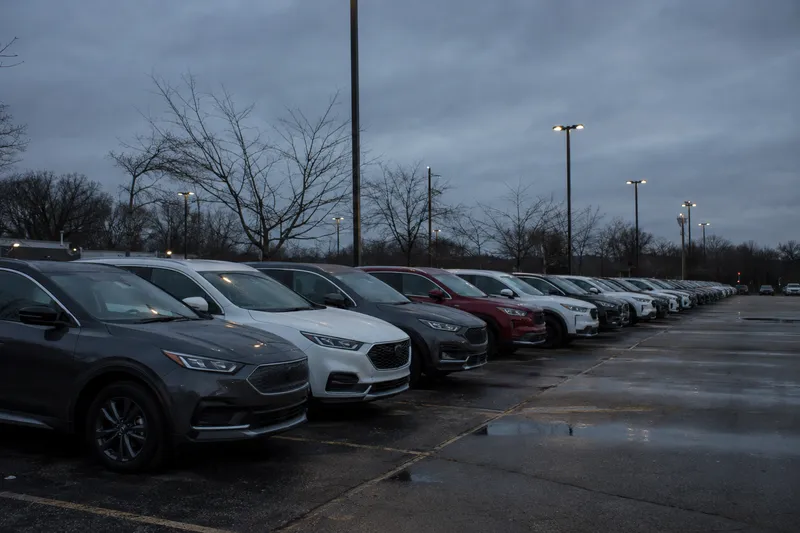
Areas
Six areas a dealership system has to cover
Different jobs, different requirements, and each one dictates the camera, not the other way round.
The lot and perimeter
Long distances, no mid-lot mounting, and a scene that is dark for most of the hours that matter. Coverage here is about the approach routes and the rows themselves, with lighting treated as part of the design. Headlights sweeping across a low-light camera will wash a frame unless the camera handles the dynamic range.
Entrances and the street frontage
The points every vehicle and every person has to cross. These are the positions where a tightly framed camera earns its place, because a controlled, predictable path through a known point is the only place identification is realistic.
The service drive
Positioned to record a vehicle's condition on arrival, not just that a vehicle arrived. That framing is the difference between resolving a damage dispute and having footage that shows the argument happening.
Service bays and technician areas
Vehicle handling, tool and equipment areas, and the routes between them. Useful for damage claims in both directions, and for the safety incidents that generate a claim weeks later.
Parts and receiving
The transitions, not the shelving — receiving, the counter, and the doors between the parts area and everywhere else. Shrinkage here is gradual and invisible until a count.
Showroom, cashier and F&I
Cash handling, customer traffic, and offices holding finance and personal information. Lower drama than the lot, and the area where the liability and privacy considerations are most worth thinking about before cameras go up.
Where we stop
What a camera on a pole can and cannot do
Dealerships are sold camera systems on the implication that footage equals identification. Across an open lot at night, frequently it does not, and it is worth being direct about why before you buy.
Identifying a person requires enough pixels on them, which means a lens and a distance chosen for that job. Cover a large lot with a handful of wide views and you get a record that something happened and roughly where — useful for an insurance claim, not for identifying anyone. The way round it is not more cameras everywhere; it is deciding which positions have an identification job and specifying those properly, while the rest provide overview.
Night is the other half of this. Most of what these systems are bought for happens in the dark, so low-light performance, illumination and how a camera handles headlights are specification decisions, not details. The design work is in commercial security camera installation, and on a lot the infrastructure to reach those positions — distance, power, pathways — often decides more than the camera choice does. That side is structured cabling.
On plates, specifically
A position that reads plates at a gate may return nothing across a lot
Whether a plate is legible depends on camera placement and angle, the lens, the lighting at that spot, and how fast the vehicle is moving.
We do not sell plate capture as a feature with a specification attached. Where it matters, it is designed as its own position, and we tell you at survey which positions can realistically achieve it.
How a plate position is designed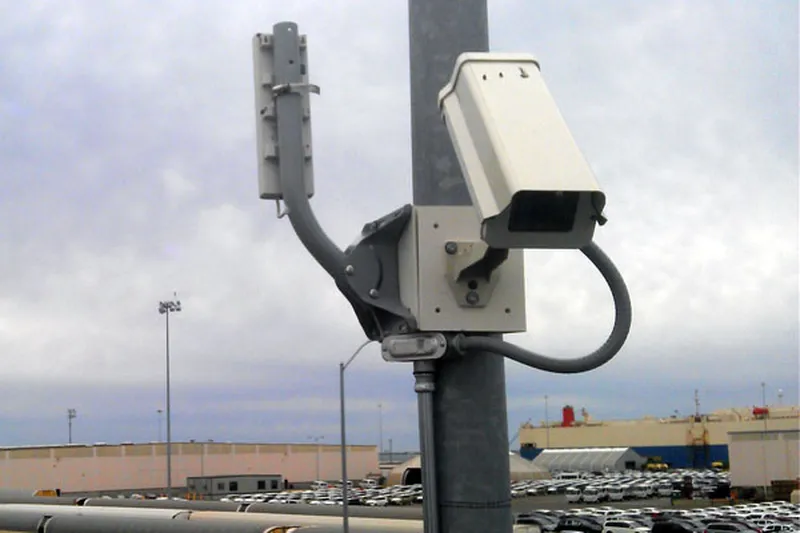
After hours
Recording it, or stopping it
This is the decision that separates dealerships that keep losing vehicles from those that stop. A recorder documents an incident. It does not interrupt one, and by the time anyone reviews the footage the vehicle has been gone for hours.
Where a lot needs the event interrupted, somebody has to be watching while the site is empty, with the ability to speak into the lot. An audible challenge from a live operator — naming what somebody is doing and where they are standing — ends most incidents immediately, because the person learns a human has seen them. That is remote video monitoring, and for a dealership it is usually the highest-value part of the system.
- Intrusion detection for the buildings. Showroom, parts, service and offices, monitored and verified against the cameras so an activation can be checked before anyone is dispatched. That is commercial alarm monitoring.
- Control of keys and restricted areas. Credentials on the key room, parts storage and the offices holding customer and finance information, producing a record of who entered and when to pair with the footage. That is commercial access control.
- Keeping it working. Lot cameras live outdoors in weather and sun, lenses collect dust and salt, mounts drift, and drives fail quietly. That is CCTV maintenance and repair.
Across a group
A request from any store, answered the same way
Name the cameras after what the lot staff call those areas, hold every store to the same retention figure, and cut permissions store by store. One platform underneath all of it.
It also means a new acquisition can be brought up to the same standard.
What a platform choice actually settles
Groups and programs
Multiple rooftops, and manufacturer requirements
Dealer groups accumulate systems one store at a time, usually from whoever was available when that store needed something. The result is that pulling footage depends on which building it came from, retention differs between stores, and nobody can compare anything across the group.
Your paperwork is the source we design to
If your OEM program specifies facility or security standards, we design to what your program requires. We will ask to see the current program document, not working from memory or from what another dealer was told. Terms differ between manufacturers and they change, so your paperwork is the source, not a recollection of it — bring the program document to the survey.
Bring the program document to the survey
If it is easier to start from the service than the vertical, the full list is on all commercial services, and the other verticals we work in are on all industries.
Common questions
Dealership security questions
Most commercial buildings hold their value inside, behind a locked door, and the security problem is the perimeter of a structure. A dealership holds most of its value outdoors, unlit for much of the night, on a lot with no meaningful perimeter and public frontage on at least one side. That inverts the design: the lot is the primary asset area, distances are long, there is nothing to mount to in the middle of it, and every position has to work in the dark. The showroom is comparatively easy.
RelatedRemote video monitoring
That depends entirely on the position, and we will not promise it as a product feature. Whether a plate is legible in footage is decided by camera placement and angle, the lens, the lighting at that spot, and how fast a vehicle is moving past it — a camera that reads plates reliably at a controlled entrance may produce nothing usable pointed across an open lot. If plate capture matters to you, it is designed as its own position with its own lens, angle and lighting — not expected as a by-product of general coverage. We will tell you at survey which positions can realistically achieve it and which cannot.
RelatedRemote video monitoring
Recording alone documents what happened, which matters for the insurance claim and not much for the vehicle. Where a dealership wants the event interrupted, the answer is somebody watching during the hours the site is empty, with the ability to speak into the lot. An audible challenge from a live operator while somebody is under a vehicle ends most incidents before anything is removed, because the person hears that they have been seen. That is monitored live coverage, and it is the single most effective change most dealerships can make.
RelatedRemote video monitoring
By documenting condition at intake as a matter of routine, not reconstructing it afterwards. That means coverage of the service drive positioned to show a vehicle arriving and its condition on arrival, plus coverage in the bays themselves. The value is as much in resolving disputes in your favour as in clearing your technicians — most of these arguments end the moment somebody can look at the intake footage, and they are otherwise settled by whoever is more insistent.
RelatedRemote video monitoring
Keys are the shortest route to a vehicle, and on most lots they are less protected than the vehicles themselves. Controlling access to the key room or key cabinet, with credentials that record who entered and when, closes the gap that cameras alone cannot — footage shows a person at the cabinet, a credential record shows which person. The same applies to parts storage and to any office holding customer or finance information.
RelatedRemote video monitoring
Yes, and it is worth doing deliberately, not as an afterthought. Parts shrinkage is rarely a break-in; it is a slow loss through a counter, a back door or a receiving area, and it is invisible until an inventory count. Useful coverage means the transitions — receiving, the counter, the door between the parts area and the rest of the building — not a general view of shelving.
RelatedRemote video monitoring
That is usually the point of bringing in one contractor. Groups accumulate different systems store by store, so a request for footage depends on which building it came from and who installed it. The reason to standardise is narrow and worth stating: when a vehicle goes missing overnight, nobody should be working out which store runs which app before anyone can look at the lot. It also makes comparing what is happening at one store against another possible at all.
RelatedRemote video monitoring
Yes. If your OEM program specifies facility or security standards, we design to what the program requires — but we will ask to see the current program document or from what another dealer was told. Program terms differ between manufacturers and they change, so we treat your paperwork as the source and design to it — not claiming to know what any particular manufacturer requires.
RelatedRemote video monitoring
Not as our own service line. We are a licensed alarm and low voltage contractor — cameras, access control, alarm and monitoring. Where a lot genuinely needs a posted guard that is coordinated under the private patrol operator licence, BSIS PPO #121089, held by Guardian Integrated Security, Inc., of which we are a DBA — the same company under its other licence, and not something we present as ours. Much of what a guard is hired for on a dealership lot, though, is presence during empty hours, and monitored live coverage with talk-down addresses a good deal of that at a different cost structure.
RelatedRemote video monitoring
Yes, and a dealership usually needs both of the licences we hold. The lot cameras, the trenching out to the light poles, the cabling back to the recorder and the intercom are C-7 low voltage work under CSLB #976737. Monitored coverage of the lot after hours, the intrusion alarm on the showroom and parts department, and access control on the key room and back of house fall under BSIS Alarm Company Operator licence ACO #7501. Both are registered to San Diego CCTV Pros and both can be checked with the agency that issued them. Fire alarm is not on that list — it takes a C-10 or a C-16 and we hold neither — so it stays with your own licensed fire alarm contractor. Commercial premises only.
RelatedRemote video monitoring