Sorrento Valley, San Diego
Commercial security in Sorrento Valley
Sorrento Valley recorded more commercial burglaries than any other San Diego neighbourhood in 2025. That number is worth stating and worth reading correctly — it is a count, not a risk rate, and this page does both.
- CSLB C-7 #976737
- BSIS ACO #7501
- CMMC certified
- SAM.gov registered
- Est. 2008
The data
104 recorded commercial burglaries, and what that does and does not mean
San Diego Police Department recorded 104 commercial burglary offences in Sorrento Valley in calendar year 2025 — the highest count of any neighbourhood in its data. Kearny Mesa, the district this business operates from, was second with 96. Citywide, SDPD recorded 1,014 commercial burglary offences in the same year.
Source: San Diego Police Department, Police NIBRS Crime Offenses, City of San Diego Open Data Portal — data.sandiego.gov/datasets/police-nibrs. Period: calendar year 2025 (citywide trend, 2020–2025). Type: COUNT of offences reported to and recorded by SDPD, not an estimate of offences that occurred. Retrieved: 2 September 2026. The commercial and residential split is derived from the California Penal Code section charged and is SDPD's own classification, not the FBI's NIBRS location-type variable. SDPD began NIBRS reporting in January 2021 and the reporting basis changes at the 2020 boundary. SDPD's own notice on the dataset states that the data is dynamic, is updated daily, and may change or be deleted as investigations proceed, so the figures move on re-extraction. SDPD's dataset spells Kearny Mesa as "Kearney Mesa".
Read this as a count, not a risk rate. The dataset contains no denominator — nobody publishes how many commercial premises sit in each San Diego neighbourhood — so a high count may reflect a dense concentration of commercial and industrial buildings, not a higher risk per business. It is defensible to say Sorrento Valley recorded the most commercial burglaries. It is not defensible to call it the most dangerous place in San Diego to run a business, and we are not saying that.
The direction of travel matters as much as the position. Commercial burglary in the City of San Diego is falling, not rising — down 34.7% between 2020 and 2025, and down 14.3% between 2024 and 2025 alone, on SDPD's own figures. We state that plainly because it is what our cited source says, and a security company describing a burglary surge in San Diego is either using stale numbers or is not using primary ones. The argument for a properly designed system here is not a crime wave. It is that a dense commercial district generates a real volume of offences, that your building is a specific building, not a statistic, and that very few of these offences are ever solved.
The full dataset — the commercial and residential series, the complete neighbourhood and division tables, clearance rates and the national context — is set out on our San Diego commercial burglary statistics guide, which is where the numbers live. This page cites what it needs and sends you there for the rest, not reprinting the tables.
Our own work
A camera position in this district
This is one of ours, in Sorrento Valley. A bullet camera and a dome on the same pole, which is the ordinary answer to a position that has to do two jobs at once: one view that identifies whoever is at a specific point, and one that holds the wider scene the identification has to be placed in.
The reason it is a pole comes back to the same constraint that decides most positions here: a pole. Business park frontages give you a facade at the wrong angle to the thing you actually need to see, and the loading area, the yard and the car park approach are all out in the open. Mounting height, containment and the route back are then the whole job.
See more of our installations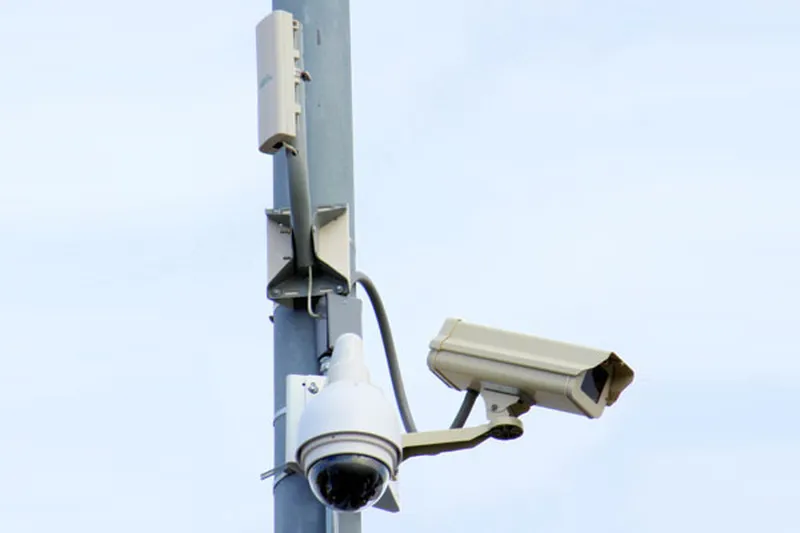
The building stock
Six things a Sorrento Valley building does to a security design
The district is business parks and research buildings. That changes almost every decision on the drawing.
The landlord owns most of what you can see
The shell, the lobby, the shared corridor, the loading area and the car park are usually the property manager's, on their retention and their release process. Your suite door inward is yours. Establishing that line is the first survey question we ask.
A controlled boundary inside the suite
Research and laboratory tenants have a further boundary the landlord never sees: the lab, the clean area, the sample or specimen store, the server room. Those need credentials and a log, and none of them needs a camera inside.
One shift, then nothing
A park of single-shift tenancies is dark and unobserved for more hours of the week than it is occupied. That is the pattern that makes live coverage worth more here than another recorder.
Loading areas that are legitimately used by strangers
Couriers, consignments and instrument deliveries arrive at a door round the back all day, which makes an unfamiliar vehicle at a loading bay entirely normal. Coverage of the approach and the door, and an alert when it is held open, are worth more than another lobby camera.
Utility yards nobody has a sightline to
Compressors, chillers, gas storage, backup power and a great deal of copper, usually behind the building where the landlord's cameras do not reach and the tenant assumed somebody else was watching.
Car parks that are exposed at both ends of the day
Staff arriving early and leaving late, vehicles standing all day, and lighting designed for parking. Camera position and lighting have to be specified together or the result is a silhouette.
A camera records a person, not a file
Research tenants ask a version of the same question: can this system protect our intellectual property. The honest answer is that it protects one half of it well and the other half not at all, and being clear about which is which is more use to you than an encouraging noise.
What a physical system genuinely does. It tells you who entered a room, at what time, how long they were in it and what they were carrying when they left. On a lab, a sample or specimen store, an instrument room or a prototype area, that is the evidence an internal investigation otherwise does not have — a missing sample set or a disappeared prototype is investigated backwards from a time, and without an access log there is nowhere for that to start. Credentials also expire: a visiting researcher, a contractor or a service engineer gets rights for the period of the visit, on the rooms the visit touches, and they stop on their own.
What it does not do, and we will not imply otherwise. If a file leaves on a laptop, on a drive, or over your network, no camera in the building recorded it. We do not do IT or network security, we do not sell anything described as data protection, and we do not offer an opinion on your data obligations. The physical and the digital halves of this problem need different suppliers, and a contractor who tells you a camera system protects your IP is describing something that does not exist.
The same discipline applies inside the suite. Cameras go on the corridor and the door — who crossed the boundary and when. Nothing goes inside a lab or a work area, which produces the record you need without pointing a camera at people doing their jobs. Egress from any controlled door is free and mechanical regardless of whether the system has power, a network or a working controller. Where a lab door carries interlocks, containment requirements or an interface to fire detection, those belong to your building engineer, your safety officer and your licensed fire alarm contractor: we do not hold a C-10 or C-16 and do not work on fire alarm systems.
Area served
Sorrento Valley, as the map draws it
The district we survey in, shown as an area. The map is here so you can see what we mean by Sorrento Valley, not to suggest we have premises in it.
Sorrento Valley
Loads Google Maps, which may set cookies.
The empty hours
The park is unoccupied for most of the week
A business park running single-shift tenancies is dark from early evening to early morning, and dark across the whole weekend. That is more hours unobserved than occupied, and it is the period in which a recorded system and a watched system stop being the same product.
- A recorder documents; an operator interrupts. Live coverage during closed hours means somebody sees an activation, assesses it against the cameras and can speak into the space. That is remote video monitoring, and on an empty park it is usually the part of the system that does something, not records something.
- Cover the approach, not only the building. The service road, the car park and the loading area are where there is still time for an intervention to matter. Coverage that begins at the wall begins too late for anybody watching live.
- Verified intrusion, not bare activations. An activation checked against the cameras before anybody is called is an assessment; an unverified one is a bell. That is commercial alarm monitoring.
- The alarm permit is a City of San Diego requirement. Sorrento Valley sits inside the city, so the authority is the San Diego Police Department: an SDPD alarm permit, Form 1067, is required before an alarm system is monitored, and it is renewed annually. We raise it during the survey, because it is the detail that most often gets missed.
- Shared parks need the arrangement written down. Where monitoring covers common areas in the landlord's demise, who is paying for it and who may request footage should be agreed with the property manager before it is installed, not discovered during an incident.
- Guarding is a separate conversation. Where a property genuinely needs a physical presence, that is coordinated under the private patrol operator licence, BSIS PPO #121089, held by Guardian Integrated Security, Inc. San Diego CCTV Pros is a DBA of Guardian — the same company under its other licence, not a third party. Guard work is Guardian's side of it; we do not quote guard hours.
What a Sorrento Valley building usually needs
- Camera design and installation. The suite entrance from your own side, the loading area, the utility yard and the car park approach, each specified against what it has to achieve in the light it actually has. That is commercial security camera installation.
- The boundary inside the suite. Labs, sample and specimen stores, instrument rooms and the server room on per-person credentials and schedules, with visitor and contractor rights that expire on their own and free mechanical egress throughout. That is commercial access control.
- Somebody watching the empty park. An operator on the property during the hours nobody is in it, able to see an activation and speak into the space. That is remote video monitoring.
- Verified intrusion detection. Monitored intrusion on the suite and the yard, checked against the cameras, so what leaves the site is an assessment. That is commercial alarm monitoring.
- Controlled entry at the suite and the goods door. A video intercom so whoever answers can see a courier or a visitor before releasing anything. That is video intercom and door entry.
- The cabling underneath it. Business park buildings mean landlord consent for routes and penetrations, ceiling access in occupied space, make-good at lease end, and existing cabling of unknown provenance left by a previous tenant. That is structured cabling.
Which of those apply depends on whether you are the tenant or the building owner, and that is the first thing we establish. A tenant is designing for their own demise and needs landlord consent for anything outside it; an owner or property manager is designing the shell, the lobby, the loading area and the car park, and is answering footage requests from tenants. The two briefs look similar on paper and share almost no positions.
If it is easier to start from the service than the location, the full list is on all commercial services, and the vertical pages are on all industries. Sorrento Valley is one district within our broader San Diego County service area.
Common questions
Sorrento Valley security questions
No, and we would rather say so than let the number do work it cannot do. San Diego Police Department recorded 104 commercial burglary offences in Sorrento Valley in calendar year 2025, more than any other neighbourhood in its data, with Kearny Mesa second at 96. Those are counts, not rates. The dataset carries no denominator — nobody publishes how many commercial premises sit in each San Diego neighbourhood — so a high count may simply reflect a dense concentration of commercial and industrial buildings, not a higher risk to any individual business in it. What is defensible is that Sorrento Valley recorded the most commercial burglaries. What is not defensible is calling it the most dangerous place in San Diego to run a business, and we are not saying that.
RelatedRemote video monitoring
From San Diego Police Department’s own Police NIBRS Crime Offenses dataset, published on the City of San Diego Open Data Portal, covering calendar year 2025 and retrieved on 2 September 2026. It is a count of offences reported to and recorded by SDPD, not an estimate of how many burglaries occurred — unreported crime is not in it. Two further caveats matter. SDPD began NIBRS reporting in January 2021, so the reporting basis changes at the 2020 boundary. And SDPD’s own notice on the dataset states that the data is dynamic, updated daily, and may change or be deleted as investigations proceed, which means the figures move slightly on re-extraction. We date every number we publish for exactly that reason.
RelatedRemote video monitoring
Usually less than tenants assume, and establishing it before anything is designed saves a great deal of argument later. The shell, the lobby, the shared corridors, the loading area, the car park and the exterior are typically the landlord’s or the property manager’s, on their retention and their release process — so a request for footage of the car park goes through them and takes as long as it takes. Your suite door inward is yours. The design that works for a tenant is therefore to cover your own entrance from your own side, so you hold an independent record of who came through it. Building systems you cannot administer are outside your control by definition and may not be able to pull from quickly. Cable routes, penetrations and anything mounted outside your demise need landlord consent, which we identify at survey, not after somebody objects.
RelatedRemote video monitoring
Partly, and we will be precise about which part, because overselling this is common. A camera and access system can tell you who physically entered a room, at what time, how long they stayed and what they were carrying when they left. That is genuinely useful when a prototype, a sample set, a notebook or a piece of instrumentation goes missing, and it is the evidence an internal investigation otherwise does not have. What it cannot do is anything about data. If a file leaves on a laptop, on a drive or over your network, no camera in the building will have recorded it. We do not do IT or network security, we do not sell anything described as data protection, and we will tell you that the physical and digital halves of the problem need different suppliers. Claiming to cover both would be the easier answer and the wrong one.
RelatedRemote video monitoring
By keeping the two things entirely separate, which is not a design preference but a hard requirement. Access control governs who can get in. It never governs who can get out: egress from a controlled door is free and mechanical, so a person leaving pushes the bar and the door opens whether the system has power, a network, a working controller or none of those. Beyond that, a laboratory door frequently has other systems attached to it — interlocks, pressure or containment requirements, and in many buildings an interface to fire detection. Those belong to your own building engineer, your safety officer and, where detection is involved, your licensed fire alarm contractor. We do not hold a C-10 or C-16 and do not work on fire alarm systems, and we will not quote around a door whose behaviour is set by a panel we are not licensed to touch.
RelatedRemote video monitoring
Somebody watching, not something recording. A business park with single-shift tenancies is dark and unobserved for more hours of the week than it is occupied, and a recorder on an empty site is an archive: it documents the visit thoroughly and does nothing about it while it is happening. Monitored live coverage during those hours puts an operator on the property who can see an activation, assess it against the cameras and speak into the space, which ends a considerable proportion of incidents at the point somebody realises a person is watching. On a shared park the approach matters as much as the building — the car park, the service road and the loading area are where there is still time for an intervention to mean anything.
RelatedRemote video monitoring
More than most tenants expect, because those are the two places a business park hides its value. The loading area is where equipment and consignments sit briefly unattended and where a vehicle can reverse up to a door legitimately. The utility yard holds compressors, chillers, gas storage, backup power and a great deal of copper, and it is usually behind the building where nobody has a line of sight to it. Both want coverage of the approach as well as the asset, and both are frequently in the landlord’s demise, not yours — which is a conversation to have with the property manager early, because a tenant paying for coverage of shared infrastructure needs the arrangement written down.
RelatedRemote video monitoring
San Diego CCTV Pros works out of 7561 Convoy Ct, San Diego, CA 92111, in Kearny Mesa — the neighbourhood sitting second on the same SDPD list Sorrento Valley heads. We have been trading since 2008. We are not going to attach an arrival time or a response window to that, here or anywhere else on this site: no such figure is evidenced, and a promise nobody can hold you to is worth nothing to you. What being local actually buys is a surveyor who can stand in your building. That is the part that changes the design.
RelatedRemote video monitoring
The same ones that cover work anywhere else in the state — licensing in California is statewide, not municipal, so there is nothing specific to Sorrento Valley or to San Diego about it. CSLB #976737 for the low-voltage installation, BSIS ACO #7501 for alarm and monitoring. What does change by location is the site itself: a business park usually has shared roads, shared parking and a landlord who owns the perimeter, so the questions worth asking early are about who controls the ground your cameras will look at, not about paperwork.
RelatedRemote video monitoring