Commercial service & repair
Security camera repair and CCTV maintenance in San Diego
Scheduled maintenance contracts and on-call repair for commercial camera systems across San Diego County — including systems installed by someone else. Lenses drift, drives fail silently, and retention quietly stops matching what your policy requires.
Maintenance & Repair
Tell us what you have, and when it was last actually checked
The failure that costs commercial operators money is not a camera going dark. A dark camera is obvious and somebody reports it the same day. The expensive failure is the system that looks like it is working — every tile on the monitor showing a picture — while a lens has drifted off its position, a drive has quietly failed in the array, or the retention everybody assumes is thirty days is really nine.
None of that announces itself. It surfaces at the worst possible moment, when somebody needs an incident recovered and the questions are suddenly specific: can you identify the person, can you read the plate, is the timestamp defensible, and does the footage still exist. A condition survey answers those before you need them to be answered, which is the only time answering them is cheap.
We take on systems we did not install, including systems whose original installer has stopped trading or stopped supporting the platform. The starting point is the same either way: establish what is actually installed, what is still supported by its manufacturer, who holds the administrative credentials, and what the recorder is genuinely retaining as opposed to what it is configured to retain. The most common finding is not a broken system. It is a working system that nobody currently has full administrative access to.
Every visit produces a written report, which matters if an insurer, a regulator or your own policy specifies a retention period you have to be able to evidence.
That is with us. We will come back to arrange a survey. If it is urgent, call (858) 222-7547.
- CSLB C-7 #976737
- BSIS ACO #7501
- CMMC certified
- SAM.gov registered
- Est. 2008
Why scheduled maintenance
A camera system degrades quietly, then fails when it matters
The failure mode that costs commercial operators money is not a camera going dark. A dark camera is obvious and gets reported the same day. The expensive failure is the system that appears to be running normally while producing footage nobody can use — and that state is invisible from the monitor wall.
The questions asked on the day
There is no way to recover the footage retrospectively
By the time someone needs an incident recovered, the questions are specific: can you identify the person, can you read the plate, is the timestamp defensible, and does the footage still exist. A system left unmaintained for a couple of years will often fail at least one of those.
Scheduled maintenance exists to catch that drift while it is still correctable, because nothing catches it afterwards.
Whether the retention you configured is the retention you have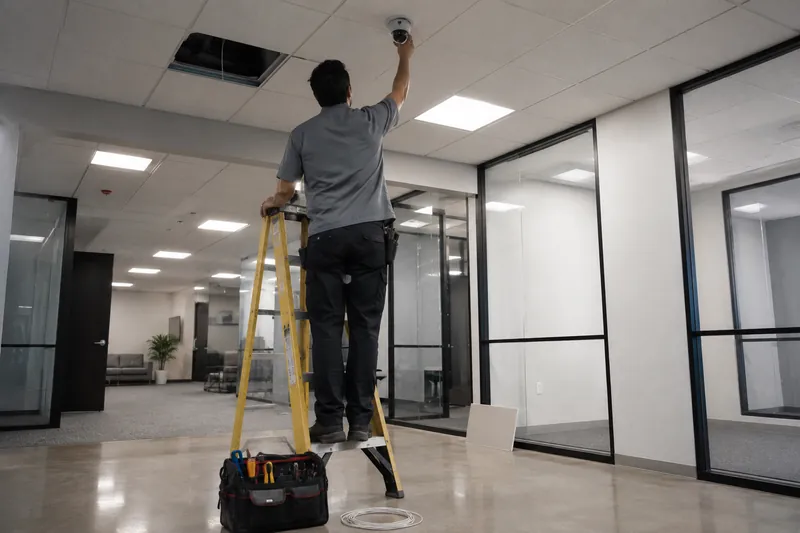
Scope
What a maintenance contract covers
Optical and physical
Lens cleaning and refocus, dome bubble replacement where hazing has set in, housing and gasket seal checks, mount and bracket tightening, and correction of cameras knocked out of alignment. Coastal San Diego sites get salt-air corrosion checks on housings and mounts; inland valley sites get thermal-stress checks on enclosures and IR illuminators.
Recording and storage
Recorder health, disk SMART status and predictive-failure review, RAID state where applicable, storage headroom, and verification that the configured retention period is the retention actually being achieved. Drives in a recorder run continuously and are a consumable — they are replaced on condition, not after they fail.
Network and infrastructure
Cable and connector inspection, PoE budget and switch port checks, terminations, and any water ingress at external junctions. Intermittent camera dropouts are far more often a network cabling or PoE fault than a camera fault, and replacing the camera does not fix them.
Configuration and firmware
Firmware review against the manufacturer's current release, time synchronisation across all devices — critical, because footage with a drifting clock is far weaker as evidence — motion and analytics zone review, and credential hygiene on any device still running a default password.
Verified retrieval test
The part most maintenance skips: actually exporting footage from an arbitrary camera at an arbitrary past time within your retention window, and confirming it plays back. Configuration reporting healthy is not the same as footage being recoverable.
Written condition report
After every visit: what was checked, what was corrected on the day, what is degrading and roughly when it will need attention, and anything that has become unsupportable. No verbal handover, no surprise invoice for work you did not agree to.
On-call repair
Security camera repair, including systems we did not install
Most of the systems we repair were installed by another contractor. We do not require you to replace a working system to become a client, and we do not treat a service call as a sales opportunity for a full rip-and-replace.
A repair visit starts with diagnosis, not a quote for new equipment. You get told what failed, why, what it costs to put right, and — where a system is genuinely at end of life for parts or firmware support — a straight answer that continued repair is the worse deal.
On-call repair
The faults we are called out to most often
Cameras dropping off intermittently
Usually PoE budget, a marginal termination, or water in an external junction — not the camera.
Recorder will not boot, or footage has gaps
Typically a failing drive or a power supply that has drifted out of tolerance.
Night footage unusable
Failed IR illuminators, a hazed dome scattering the IR back into the lens, or a camera specified without the low-light performance the scene needs.
Image soft or misframed
Varifocal lenses drift, and cameras get knocked by ladders, forklifts and roller doors.
Nobody can retrieve footage
Sometimes a genuine fault, often that the person who knew the system has left and no one has the credentials or the procedure.
Storm and water damage
Failed seals on external housings, typically surfacing after the first serious rain of the season.
Before any contract
What a condition survey covers
Every maintenance agreement starts with a survey of the existing system. We will not quote a maintenance contract off a camera count over the phone, because the camera count is the least useful number about a system.
- Every camera position, what it currently covers, and whether that still matches what the site needs.
- Actual recorded image quality at each position — day and night — instead of the live view, which flatters the system.
- Recorder, storage and network condition, and true retention versus configured retention.
- Cabling and power infrastructure, including anything non-compliant or unsafe left by previous work.
- Equipment supportability: whether firmware and parts are still available for what you have.
- Where equipment procurement policy applies, whether the installed hardware meets NDAA §889 requirements — relevant for government, defence-adjacent and federally funded sites.
If you want to check the retention half of that yourself before anyone visits, how long security cameras keep footage sets out how, and the questions we will ask on the day are in our free site survey checklist.
You get the findings in writing whether or not you go on to contract with us.
Also a documentation problem
Show the system held it, not that it was configured to
If your insurer, your regulator or your own policy specifies a retention period, you need to be able to show the system actually held it.
Every maintenance visit we run produces a written report you can file against that requirement.
Book a condition survey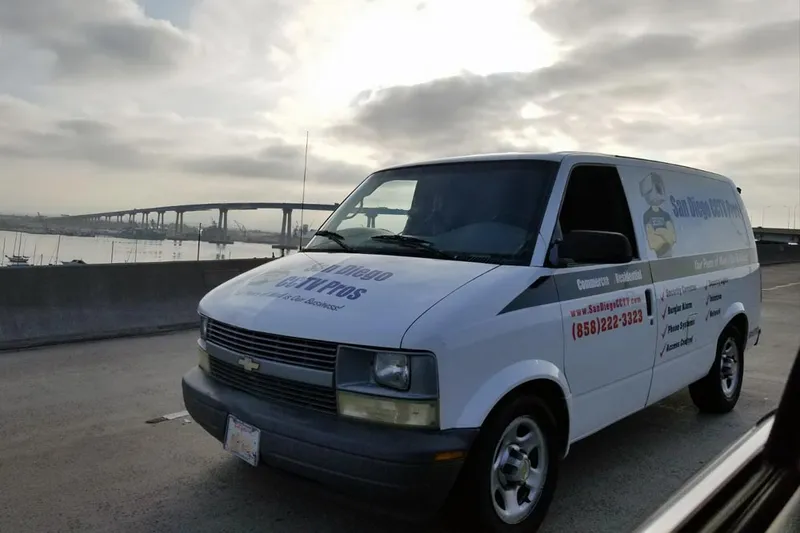
Common questions
CCTV maintenance and repair questions
Yes. Most of the systems we maintain were installed by someone else. We start with a condition survey of what is already on site — cameras, cabling, recorder, storage and network — and give you a written account of what works, what is failing and what is no longer supportable. You do not have to replace a system to get it maintained.
Scheduled site visits at an agreed interval, with each visit covering lens cleaning and refocus, housing and seal checks, mount and bracket tightening, IR illuminator checks, cable and connector inspection, recorder health and disk SMART status, firmware review, time synchronisation, and a verified test that footage is actually recording and retrievable at the retention you are contracted to hold. You get a written report after every visit.
We do not publish response times or quote a repair window in advance, because how fast a technician can be on site depends on your location, the fault and what else is booked that day. We are a San Diego company with local technicians, so we are not dispatching from out of state — but that is not a number, and we are not going to turn it into one to win the question.
Almost always one of four causes: the camera is recording but at a resolution or frame rate too low to identify anyone; the retention period expired before anyone went looking; the lens is dirty, fogged or knocked out of focus; or the scene is backlit and the camera has no wide dynamic range to handle it. All four are found by a condition survey and none of them announce themselves — the system looks like it is working right up until you need the footage.
Yes. A large share of commercial sites in San Diego still run coax-based HD systems that are perfectly serviceable. We repair and maintain them, and we will tell you honestly when a system has reached the point where parts availability or firmware support makes continued repair a worse deal than replacement.
Yes, and on a repair job it is the second licence that matters. Anyone with a C-7 can replace a camera; taking over a system that is monitored, or that controls doors, is alarm company work and needs BSIS ACO #7501. We hold both that and CSLB #976737. The practical consequence for you is that we can adopt a system somebody else installed without you having to keep two contractors on the account — with one exception, which is that if the panel is tied to a fire alarm we stop at that boundary. No C-10, no C-16.
Related services
Other commercial services
Access Control Systems
Card, fob and mobile credential systems — readers, controllers, electric locking hardware, and integration with the camera system.
Biometric Access Control
Fingerprint, facial and palm credentials for the commercial openings where a credential must not be transferable — server rooms, cash handling, controlled inventory and pedestrian gates. Installed under ACO #7501, with the template storage and retention questions settled at design.
Commercial Alarm Monitoring
Central-station monitoring for commercial intrusion alarms — panels, contacts, motion and glassbreak detection, video verification against the camera system, and takeover of an existing panel. Intrusion only.
Gate Access Control Systems
Access control at the vehicle gate and the perimeter — readers, keypads, mobile credentials, transmitters, telephone entry and loop and safety-device integration, wired and commissioned under C-7 and ACO. The gate operator itself is your gate contractor's; we coordinate with them.