Commercial plate recognition
Licence plate recognition for San Diego commercial sites
Plate-reading camera positions for gates, yards and lots, designed as their own position with their own lens, angle and lighting, and confirmed at survey, not promised in a brochure. We do not sell plate capture as a feature with a specification attached, and this page explains why nobody honestly can.
Plate Recognition
We will not quote you a read rate before we have seen the entrance
Plate reading is the one service on this site where we refuse to put a number in front of you early, and the reason is not modesty. A read rate is not a property of a product. It is a property of a specific position at a specific entrance, and nobody who has not stood at that entrance can tell you what it will be. A brochure figure was measured somewhere that is not your gate.
What decides it is geometry and light. A plate presents itself squarely when a vehicle travels along a predictable line at a predictable speed — a single lane at a gate is the easy case, a wide approach where vehicles arrive at whatever angle suits them is the hard one. The plate wants to be close to face-on: a camera mounted too high looks down at it, one mounted off to the side looks across it, and both distort the characters. Headlights at night and low sun at the wrong hour do the rest.
This is also why your existing cameras probably cannot do it. A camera covering a scene and a camera reading a plate want opposite things from a lens, an exposure and a mounting position, and a position asked to do both usually does neither well. It is its own position, with its own job.
There is a data policy question underneath it too — what is retained, for how long, and who can query it. That decision is yours, and we will set out what the system makes possible.
That is with us. We will come back to arrange a survey. If it is urgent, call (858) 222-7547.
- CSLB C-7 #976737
- BSIS ACO #7501
- CMMC certified
- SAM.gov registered
- Est. 2008
The position we take
We do not sell plate capture with a specification attached
Almost every page on this subject leads with an accuracy number. We are not going to.
The reason is not modesty: the figure is not a property of the product. It is a property of a position at a specific entrance, and nobody who has not stood at that entrance can tell you what it will be. Whether a plate is legible is decided by camera placement and angle, the lens, the lighting at that spot, and how fast the vehicle is moving past it. A position that reads reliably at a controlled single-lane gate can return nothing usable pointed across an open lot where vehicles arrive at an angle. Same software, same camera, different answer.
So this page tells you what makes a position work, what plate reading is genuinely good for, and where it disappoints people. Then we come and look at your entrances and tell you which ones can support it. That is a less impressive proposition than a number on a datasheet, and it is the one that survives the install.
Why the answer is usually no
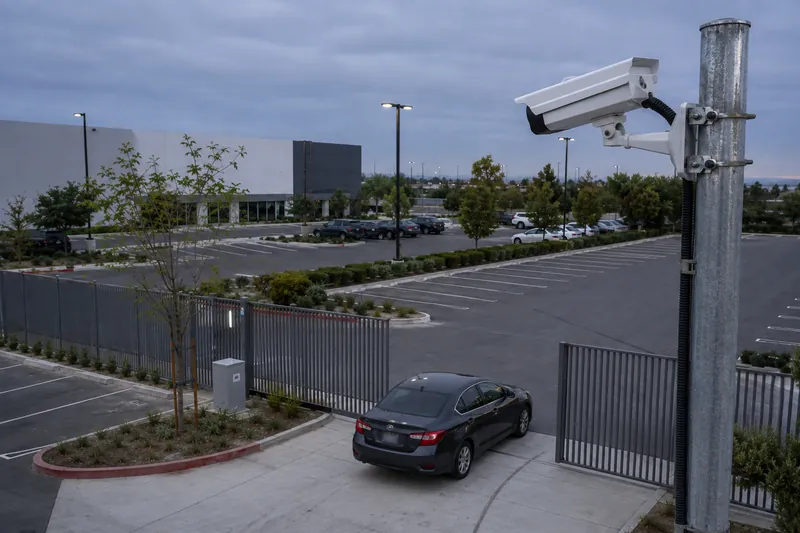
A plate and a scene want opposite cameras
A general-coverage camera is chosen to show what is happening across an area. That means a wide field of view, a mounting position that takes in the scene, and exposure settings that make the whole picture look reasonable. A plate is a small, retroreflective, frequently fast-moving object, and reading it wants a narrow view, a particular angle and exposure tuned for a bright reflective rectangle instead of for the scene around it.
Those requirements pull in opposite directions, which is why one camera rarely does both jobs well.
- Wide field of view against a narrow one
- Exposed for the scene against exposed for a bright reflective rectangle
- Mounted to take in the area against aimed at where the plate will be
The mechanics
What makes a plate-reading position work
Constrained geometry first
A plate presents itself squarely when a vehicle travels along a predictable line at a predictable speed. A single lane at a gate is the easy case; a wide approach where vehicles arrive at whatever angle suits them is the hard one, and sometimes the impossible one.
Angle, horizontally and vertically
The plate wants to be close to face-on. A camera mounted too high looks down at it, one mounted off to the side looks across it, and both distort the characters. This is the constraint that most often rules out an otherwise convenient mounting point.
Light at the plate
Not light in general. Light on the plate itself. Plates are retroreflective, so a position designed for the job with appropriate illumination often performs well after dark, while a well-lit forecourt with the sun behind a vehicle does not.
A lens chosen for the job
A plate is a small object with fine detail. The lens and the exposure wanted for reading it are different from what makes a scene look right, which is why one camera rarely does both well.
Speed at the point of capture
How fast the vehicle is moving where the camera sees it, not how fast the road is. A slowing approach into a gate is very different from a vehicle passing a lot entrance without stopping.
The plate itself
Dirty, damaged, obscured, tilted, out-of-state or novelty plates all degrade reading, and no design compensates for a plate that cannot be seen. This is a condition of the world, not a setting.
The common disappointment
Why your existing cameras probably cannot do this
The request usually arrives as a reasonable-sounding question: we already have cameras covering the entrance, can they read plates? The honest answer is usually no, and it is worth understanding why, because the reason is not that the cameras are bad.
Occasionally an existing position happens to be right, and where it is we will say so. More often the answer is that plate reading needs its own camera at its own position, which is a smaller and more predictable piece of work than most people expect: one position, done properly, instead of an upgrade to the whole system. Where new positions are needed, that sits under commercial security camera installation.
What plate reading is not is a general analytic. Person and vehicle classification, line crossing, intrusion zones and loitering run perfectly well on ordinary well-placed cameras, and those are covered under video analytics. Plates are the exception that needs a dedicated position.
Where the geometry tends to cooperate
Plate reading works where the site already constrains how vehicles move. That is a design fact, not a preference, and it is why the same technology is straightforward at one property and marginal at the one next door.
- Gated yards and compounds. The best case: vehicles slow, arrive one at a time, and travel along a line somebody chose. Yard and dock operations are covered under warehouse and logistics security.
- Controlled car park entrances. A barrier or a single-lane entry does most of the work for you before the camera is even specified.
- Dealership and vehicle lots. Where the stock is vehicles, knowing which ones moved and when has obvious value: covered under auto dealership security.
- Managed residential and commercial parking. Resident and tenant vehicles are a stable known list, which is exactly the case plate-based entry suits: see multifamily and apartment security.
- Where it usually does not fit. Wide open frontages, multi-lane approaches with no constraint, and any position where vehicles arrive at whatever angle they like. We will tell you at survey instead of fitting it and hoping.
What it is for
Three things commercial sites use plate reading for
Searchable footage
The quietly most useful one. Once plates are text, an investigation becomes a query instead of an afternoon of scrubbing through recordings: which vehicle, when, how many times before. Most sites discover this is the feature they actually wanted.
Gate access for known vehicles
The vehicle becomes the credential and the driver presents nothing. It suits fleets and regular vehicles, and it always needs a fallback for everybody else, and that side is covered under gate access control.
Exception alerting
A specific vehicle you have asked to be told about, flagged when it appears. Narrow, useful, and deliberately not the same thing as watching everybody who arrives, which produces a great deal of data with no question attached to it.
Where it connects
What plate reading sits alongside
A plate read is a fact about a vehicle. It becomes useful when it is attached to something that acts. At a gate that is the access control, under gate access control, and note that we install the access control, not the gate operator itself, which stays with your gate contractor.
Where a site is watched out of hours, a plate event can be one of the things that puts a live view in front of an operator, alongside the classified detections described under video analytics. What the operator then does about it is remote video monitoring, which is a separate service, not a feature of the camera.
One position, designed properly
A plate-reading deployment is not a system upgrade. It is normally one or two dedicated positions added to whatever you already have, and the work concentrates almost entirely in getting those positions right.
- Stand at the entrance first. Watch how vehicles actually arrive: the line they take, where they slow, whether they queue, what the sun does at the end of the day. None of that is visible on a site plan.
- Choose the capture point, then the mounting. The point where the plate is presented squarely at a manageable speed decides where the camera goes, not the other way round.
- Design the lighting with the camera. Illumination at the plate is part of the position, not an accessory added afterwards if results disappoint.
- Say what it will not do. Which vehicles and conditions will read poorly, and what the fallback is when a plate does not resolve, because there will be some, at every site.
- Confirm on site, not on paper. The position is proved against real vehicles at real speeds in real light before it is signed off, and adjusted where it needs to be.
- Plan the cleaning. A plate-reading lens that nobody wipes degrades quietly, and the first anyone knows is a run of reads that did not happen.
Plate data is a policy decision
A plate-reading system produces a durable record of which vehicles came and went and when. That is a data holding, and it deserves a decision not a default.
What is retained, and for how long
Plate reads accumulate whether or not anybody looks at them. Deciding a retention period deliberately is the difference between a useful investigative tool and an open-ended holding nobody owns.
Who can search it, and what is logged
A searchable record of vehicle movements is powerful, which is exactly why access to it should be defined and recorded in the same way access to footage is.
Not our determination
These are policy questions for your business and your counsel. This is not legal advice. We will tell you plainly what a given system records and for how long by default, and configure it to whatever you decide.
A specific instrument with a defined job
None of that makes it a poor investment. It makes it a specific one, and sites that buy it understanding the job are consistently happy with it. Sites that buy it expecting a system that logs everybody who ever comes near the property are the ones that end up disappointed.
The start is the same as everything else here: we look at the actual entrance, watch how vehicles actually behave at it, and tell you plainly whether plate reading is realistic there and what it would take. If the answer is that your entrance will not support it reliably, that is what you will be told. Commercial premises only, not private residences.
Bought understanding the job
What a plate-reading position will not do
It will not identify a driver: that is a different camera at a different angle, and a plate tells you about a vehicle, not about a person.
It will not read a plate that is not presented to it, so a vehicle reversing in, one carrying no front plate, or one following closely enough that the camera never sees the second plate will simply not produce a read. And it will not turn a poorly constrained entrance into a well constrained one; where the geometry fights the camera, the fix is at the entrance and not in the software.
Detection that needs no plate at all
Common questions
Licence plate recognition questions
It is a camera position and the software behind it that reads the plate on a vehicle and turns it into text a system can act on. Once a plate is text, it can be matched against a list: to open a gate for a known vehicle, to flag one you have asked to be told about, or simply to make footage searchable by plate instead of scrubbing through hours of it. The reading is the hard part, and everything useful depends on getting one position right, not on the software being clever.
RelatedParking lot incidents
We will not give you a number, and we would treat any figure quoted to you without a site visit with real caution. Whether a plate is legible is decided by camera placement and angle, the lens, the lighting at that spot, and how fast the vehicle is moving past it. A position that reads reliably at a controlled single-lane entrance can return nothing usable pointed across an open lot where vehicles arrive at an angle and at speed. What we will do is look at your entrances, tell you which ones can realistically support plate reading and which cannot, and be specific about what each position will and will not deliver.
RelatedParking lot incidents
Constrained geometry, above all. A plate presents itself squarely to a camera when the vehicle is travelling along a predictable line at a predictable speed, which is why a single lane at a gate is the easy case and a wide open approach is the hard one. Beyond geometry it is a question of lighting at the plate, not lighting in general, an angle that keeps the plate close to face-on both horizontally and vertically, and a lens chosen for that specific job, not for a general view. Every one of those is a design decision made at the position, which is why plate reading is designed as its own camera instead of expected from one already there.
RelatedParking lot incidents
Usually not, and that is the single most common disappointment in this part of the industry. A general-coverage camera is chosen to show what is happening across an area, which means a wide field of view, an angle that suits the scene, and exposure settings that make the whole picture look right. A plate is a small, retroreflective, often fast-moving object, and reading it wants the opposite of all three. Occasionally an existing position happens to be right. More often the answer is that plate reading needs its own camera, and saying so at survey beats taking the work and handing back footage you cannot use.
RelatedParking lot incidents
Three things, in roughly this order. Gate access, where a known vehicle is admitted without anyone presenting anything. Investigation, where making footage searchable by plate turns an afternoon of scrubbing into a query, which is what most sites value once they have it. And exception alerting, where a specific vehicle you have asked to be told about is flagged when it appears. What sites rarely use it for successfully is blanket surveillance of everyone who arrives, because that generates a large volume of data with no question attached to it.
RelatedParking lot incidents
Night is not automatically the harder case, which surprises people. Plates are retroreflective, so a position designed for plate reading with appropriate illumination can perform well after dark, sometimes better than in daylight, because headlights and daylight glare are their own problems. What genuinely degrades reading is a dirty, damaged, obscured or non-standard plate, a vehicle at an unusual angle, heavy rain or fog between the camera and the plate, and a lens nobody has cleaned. Those are conditions, not settings, which is why a deployment includes a maintenance expectation instead of assuming the position stays as commissioned.
RelatedParking lot incidents
That is your decision and it is worth making deliberately, not accepting a default. A plate-reading system produces a record of which vehicles came and went and when, and the questions that matter are what is retained, for how long, who can search it, what is logged when they do, and whether any of it is shared. Those are policy questions for your business and your counsel, and this is not legal advice: we are not going to tell you what your obligations are. What we will do is tell you plainly what a given system records and for how long by default, so you can take an accurate description to whoever advises you and we can configure it to whatever they decide.
RelatedParking lot incidents
It supplements one. Plate reading suits fleets and known regular vehicles, and it is genuinely convenient because the driver presents nothing. But every site has vehicles that are not on the list: deliveries, contractors, visitors, the hire van somebody took because their own was in the workshop, and a gate that only opens for recognised plates strands all of them. So a plate-based entrance always has a fallback, whether that is a transmitter, a mobile credential or a telephone entry station, and on most sites the fallback carries more traffic than the plate reading does.
RelatedParking lot incidents
Two different answers, which is the point of asking it as one question. The camera, its pole, its power and the reader integration are ours under CSLB #976737, with BSIS ACO #7501 covering the access-control side where a read triggers a door or a barrier. The gate operator itself — the motor, the safety edges, the loop detectors — is not ours. That is gate work, and we would rather tell you to call your gate contractor than quote around the edge of a licence we do not hold.
RelatedParking lot incidents
Related services
Other commercial services
Mobile Surveillance Units
Self-contained camera units we own and deploy to sites with no permanent power, no network and no reason to justify a fixed install — construction, vacant property, temporary yards and events. Repositioned as the site changes, and watched live rather than only recorded.
Panic & Duress Buttons
Fixed and mobile duress devices for commercial premises — silent hold-up alarms at counters and reception, wearable and app-based buttons for staff who move, wired into monitored alarm response and paired with camera verification. Installed and monitored under ACO #7501.
Remote Video Monitoring
Off-site operators watching commercial camera feeds live rather than reviewing them after the fact — event-driven response, audio talk-down, verified escalation to police, and after-hours cover for sites nobody is standing on. Runs on the cameras you already have.
Video Analytics
Detection running on the cameras and recorders you already have — person and vehicle classification, line crossing, intrusion zones, loitering, people counting and heat mapping. What makes a monitored system event-driven instead of a wall of screens nobody watches.