The decision, not the product
Can a virtual security guard replace the guard you are paying for?
If you are paying for a guard, or you have been quoted for one, the real question is not which supplier to use. It is whether the thing you are buying is a person on site or the outcome that person produces. Those are not the same purchase, and for some sites only one of them is necessary.
Virtual guarding
Whether you need a person on site, or the outcome one produces
Almost everyone who asks us about virtual guarding is already paying for something — usually a guard on a night or weekend shift at a yard, a lot, or a site under construction. So the real question is not which supplier to use. It is whether the thing you are buying is a person on the property or the outcome that person is there to produce, because those are two different purchases sold under one word.
Technology replaces a guard for the jobs that only ever needed somebody watching: seeing an event, assessing it, challenging it, and escalating it to someone who can act. It replaces nothing that needed a person physically present — opening up, escorting, holding a gate, responding on foot, or being a body on the ground. A site that swaps one for the other without separating those two lists is usually disappointed within a month.
Read that with our interest declared. We hold BSIS ACO #7501 and sell monitoring, which is the technology side. The private patrol operator licence, BSIS PPO #121089, belongs to Guardian Integrated Security, Inc., of which this business is a DBA. We will tell you plainly which of the two your site actually needs, including when the answer is the one we do not sell.
What you will not get from us is a cost comparison table or a deterrence percentage. We do not hold sourced figures for either and will not print unsourced ones on a page about how you spend money.
That is with us. We will come back to arrange a survey. If it is urgent, call (858) 222-7547.
- CSLB C-7 #976737
- BSIS ACO #7501
- CMMC certified
- SAM.gov registered
- Est. 2008
Where the question comes from
Two different purchases sold under one word
Almost everyone who asks us about virtual guarding is already paying for something — usually a guard on a night or weekend shift at a yard, a lot or a site under construction — and the question has arrived because the cost of that shift became visible. The guarding industry answers that nothing replaces a person. The technology industry answers that a camera does everything a guard does for a fraction of the price. Both are selling.
The useful answer separates what you are buying from what you are paying for, because the two came bundled and only one of them is expensive. A site posting a guard overnight is usually buying deterrence and early warning: something happens, somebody notices, somebody acts. The guard is the mechanism, not the goal. Where the site is closed and empty that mechanism has a substitute. Where the shift involves a staffed entrance, deliveries, or anything needing hands and judgement in the building, the presence is the goal and there is nothing to substitute.
The question that has an answer
Which parts of the shift need a person
So the honest form of the question is not "is virtual guarding as good as a guard". It is "which parts of what my guard does need a person". That has an answer for your specific building, it is usually answerable from the last few shift logs, and the parts that need a person are visible in about ten minutes of standing in the place — which is rarely visible in an email.
A survey answers it in the specific. We will tell you which hours we think we can cover and which we cannot, including where the answer is that you should keep the guard.
Ask us for a site survey
Evidence
A guard and a virtual guard are not two grades of the same product
What a physical guard uniquely provides is presence
A person on site can walk the property, hold or open a door, escort somebody off, take a delivery, intervene physically within their training, and be a witness who was actually there. None of that is available to an operator watching a screen, and no camera specification changes it.
What a watched camera uniquely provides is verification
Operators covering many sites at once can see an incident while it is happening, challenge somebody over on-site audio, and escalate with a description of what they are watching instead of a bare signal. They can also cover the whole perimeter at once, which one person walking a patrol route cannot. How that is actually delivered: remote video monitoring.
An unverified alarm is a weak instrument
This is the one number on this page. San Diego Police Department was dispatched to 17,075 burglary-alarm calls in the city in 2025; 16,728 of them — 97.97% — closed with no crime report and no arrest. Whatever you buy, the thing that changes the quality of that call is somebody having looked first. Derived from San Diego Police Department, Police Calls for Service, City of San Diego Open Data Portal, call type 459A, calendar year 2025. Retrieved 2 September 2026. Our own calculation from published disposition codes, NOT an official SDPD false-alarm statistic: a no-crime-outcome disposition includes cancelled calls and calls where no report was required, and is not the administrative determination SDPD uses for permits and billing.
The words are marketing, not different services
"Virtual guarding", "remote guarding", "virtual security guard" and "live video monitoring" all describe the same arrangement. The guarding words borrow the authority of a person standing on your property to describe a service in which nobody is standing on your property. We use the plainer name for our own page. The service under its plain name: remote video monitoring.
We publish no cost or response-time comparison, deliberately
You will find pages that put a guard hourly rate beside a monitoring fee, or quote an average response time. We hold neither figure in a form we would stand behind for your building, so we do not print one. Both are priced against a defined scope, and a comparison built on numbers nobody sourced is worse than no comparison.
Comparison
What each one is actually for
| A guard on site | Virtual guarding | |
|---|---|---|
| Someone present on the property | Yes | No — this is the whole difference |
| Coverage of the full perimeter at once | No — one patrol route at a time | Yes, every camera position simultaneously |
| Challenge an intruder while it is happening | In person, within their training | By on-site audio, from off site |
| Verify before police are asked to attend | Yes | Yes |
| Open, close, escort, keyhold, take deliveries | Yes | No |
| Physical intervention | Within their training | No |
| Scales to long empty hours | Priced by every hour covered | Priced by what is watched and for how long |
| Who provides it here | Guardian Integrated Security, Inc. — BSIS PPO #121089 | San Diego CCTV Pros — BSIS ACO #7501 |
No costs, response times or deterrence percentages appear in this table. We do not hold sourced figures for them and will not print unsourced ones on a page about how to spend money.
The answer
What it means
Audit the shift before you price anything
Write down what the guard actually did across their last four shifts, line by line, then mark every entry that required a person to be physically present. What survives the marking is what you still need a guard for. Most of the time this exercise is more decisive than any quote, and it costs nothing.
Closed sites after hours are where technology substitutes best
A site that is locked, empty and needs nobody until morning is being guarded for observation, and observation is the job a remote operator does at least as well and across the whole perimeter at once. The overnight problem in detail: after-hours coverage.
Manned points and hands-on duties are where it does not
A staffed lobby, a gate somebody has to work, keyholding, escorting, internal incident response, opening and closing — these are presence, and a camera does not do them. If your guard’s shift is full of these, monitoring is an addition to what you have, not a replacement for it. The unattended-entry alternative: video intercom and door entry.
The common answer is both, arranged differently
Plenty of sites end up with monitoring covering the closed hours and a reduced or repositioned guard presence covering the open ones. That is usually a better outcome than either extreme, and it is why we would rather survey the site than sell you a category. Where an activation still has to raise somebody: commercial alarm monitoring.
Some building types are decided before the survey starts
Construction sites, warehouse and logistics yards, multifamily parking structures and dealership lots share the same shape — large, outdoor, valuable, and empty for long predictable stretches. They are the clearest fits for substitution, and they are the ones we are asked about most. By building type: construction, warehouse and logistics, multifamily, auto dealership.
What we hold, and what we do not
Which of these two we are actually licensed to sell
San Diego CCTV Pros is a DBA of Guardian Integrated Security, Inc., and the licences appear under Guardian's name on the state registers — worth stating before you look them up. The licence covering this work is BSIS ACO #7501, which California requires to sell, install, service and monitor alarm systems including monitored CCTV; installation and cabling sit under CSLB C-7 #976737.
Whose lane is whose
We do not sell guard hours under this brand
BSIS PPO #121089, the private patrol operator licence, is Guardian's. Guard and patrol work is Guardian's lane. Where a site genuinely needs a person posted we coordinate that through Guardian, and this page should not be read as a pitch to cancel them. We also hold no C-10 or C-16, so fire alarm work is coordinated with your own licensed fire contractor.
The practical consequence for you is that our incentive on this page runs one way only. If the answer for your site is that you need to keep the guard, saying so costs us nothing, which is roughly the minimum standard you should hold any supplier to on this question.
The delivery side of what we do sell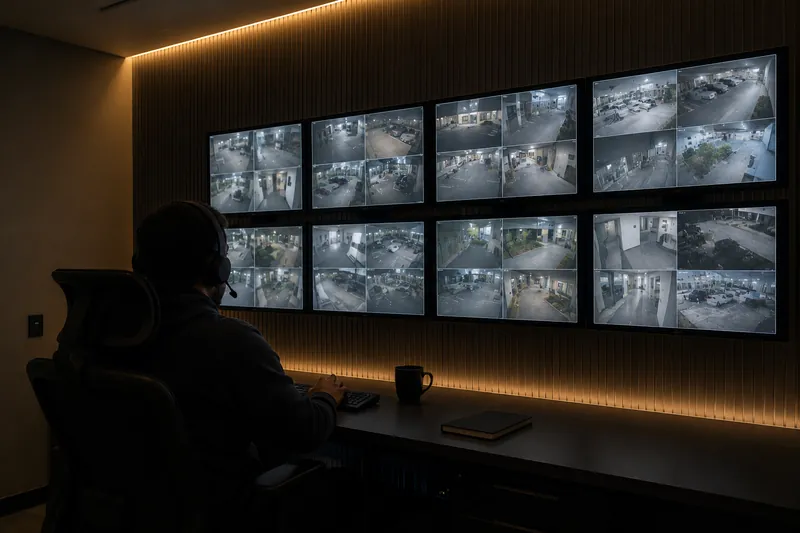
Common questions
Virtual guarding questions
No, and the word "guard" in the product name is the source of most of the confusion. A physical guard is a person present at your property who can walk it, hold a door, escort somebody out, sign for a delivery and be a witness. A virtual guarding service is trained operators watching your cameras live from off site, who can see an incident developing and act on it under an agreed plan — but who are not there. Neither one is a substitute for the other in general; they are only substitutes for each other in the specific jobs where presence is not what you were buying.
RelatedRemote video monitoring
A recording answers questions after the fact. A watched camera can produce a response during the incident: an operator sees the activity, can challenge somebody over on-site audio, and can escalate to police or to a keyholder with a description of what they are watching, not a bare alarm signal. The difference is verification — somebody has looked before anyone is asked to respond.
RelatedRemote video monitoring
Not under this brand. San Diego CCTV Pros is a DBA of Guardian Integrated Security, Inc., and the private patrol operator licence, BSIS PPO #121089, is Guardian’s. Where a site genuinely needs a person posted, that is coordinated through Guardian, not sold here. What we hold in our own right for this work is BSIS ACO #7501, the alarm company operator licence that covers monitoring.
RelatedRemote video monitoring
Sometimes entirely, sometimes partly, and sometimes not at all — and the honest answer depends on what your guard is actually doing during their shift. If the shift is overwhelmingly presence and observation on a closed site after hours, monitoring covers most of it. If the shift includes access control at a manned point, escorting, keyholding, incident response inside the building, or anything requiring hands, it does not. The practical exercise is to write down what the guard did on their last four shifts, then mark which entries needed a person on site.
RelatedAfter-hours coverage
It is one of the strongest fits, because a construction site after hours is closed, unlit, has nothing that needs a person on site until morning, and is expensive to guard continuously across a long programme. Cameras can also be repositioned as the site changes, which a fixed guard post cannot.
RelatedConstruction site security
We do not publish a figure for either, and we would be sceptical of anyone who does without seeing your site. What we can say about the shape of it is that guarding is priced by hours covered and monitoring is priced by what is being watched and for how long, so the two scale differently as a site grows or as covered hours extend. The only way to compare them for your building is to price both against the same defined scope, which is what a site survey is for.
RelatedRemote video monitoring
Related services
Other commercial services
Access Control Systems
Card, fob and mobile credential systems — readers, controllers, electric locking hardware, and integration with the camera system.
Biometric Access Control
Fingerprint, facial and palm credentials for the commercial openings where a credential must not be transferable — server rooms, cash handling, controlled inventory and pedestrian gates. Installed under ACO #7501, with the template storage and retention questions settled at design.
CCTV Maintenance & Repair
Scheduled preventive maintenance contracts and on-call repair for commercial camera systems — including systems we did not install. Camera replacement, cabling faults, NVR and storage failures, firmware and retention audits.
Commercial Alarm Monitoring
Central-station monitoring for commercial intrusion alarms — panels, contacts, motion and glassbreak detection, video verification against the camera system, and takeover of an existing panel. Intrusion only.