Commercial biometric access control
Biometric access control for San Diego commercial buildings
Fingerprint, facial and palm credentials for the openings where a credential must not be transferable — server rooms, cash handling, controlled inventory and pedestrian gates. Installed under BSIS ACO #7501, with the template storage and retention questions settled at design rather than discovered afterwards.
Biometric Access
Which openings actually need a credential nobody can lend
Biometrics are worth installing at a small number of openings and are the wrong tool almost everywhere else, so the first thing worth establishing is which of yours are which. The entire case rests on one property: the credential cannot be handed to somebody else. A badge is lent, a fob sits on a hook, a code is shared with a colleague who forgot theirs. A fingerprint, a face or the vein pattern in a palm cannot travel that way.
Every complication follows from the same property. Because the credential is part of the person, it cannot be reissued when it is compromised, it cannot be handed back when they leave, and enrolling somebody is a slower and more personal act than printing a card. That is why the openings worth doing are the ones where transferability is the actual risk — a server room, a cash-handling area, controlled inventory, a pedestrian gate — and why a general building credential system is a different question answered under commercial access control.
There is also a policy decision underneath the product one, and it belongs to you rather than to us: what is captured, where the template is stored, who can reach it, and how long it is kept. We will tell you what each reader type stores and where, and what happens at enrolment and at exit. What we will not do is quote laboratory accuracy figures at you. A number measured under test conditions says nothing about a reader on your loading dock in February.
That is with us. We will come back to arrange a survey. If it is urgent, call (858) 222-7547.
- CSLB C-7 #976737
- BSIS ACO #7501
- CMMC certified
- SAM.gov registered
- Est. 2008
The explainer
One property, and everything that follows from it
A biometric access control system replaces the thing a person carries with a measurement of the person. At enrolment a reader captures a fingerprint, a face or the vein pattern in a palm and stores a template derived from it. At the door it takes a fresh reading and compares the two.
If what you need is a credential system for a building — readers, controllers, doors, permissions and revocation across the estate — that is a different question and it is answered under commercial access control. This page is about one decision inside it.
The single property
The credential cannot be handed to somebody else
The whole case for biometrics rests on one property: the credential cannot be handed to somebody else. Every other access credential can be. A badge is lent, a fob is left on a hook, a code is told to a colleague, a transmitter stays on the visor of a shared truck. Where that sharing is the thing you are actually trying to stop, biometrics are the only credential that stops it.
Every complication follows from the same property. Because the credential is part of the person, it cannot be reissued when it is compromised, it cannot be handed back when they leave, and it is regulated personal information, not an asset on an inventory. That is why this page spends as much space on where biometrics do not belong as on where they do.
The credential system this sits inside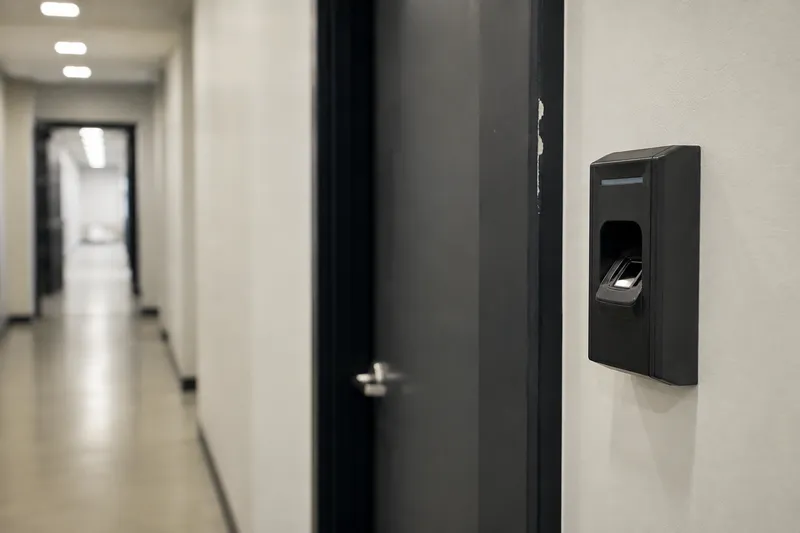
The modalities
Fingerprint, facial and palm
Fingerprint
The most established modality and the cheapest per opening, which is why it is the default proposal. Its limit is hands: gloves, moisture, dirt and wear are daily conditions in industrial, kitchen and cold-store environments, and a reader that fails those users is a reader people work around.
Facial
Presented without touching anything, which suits high-traffic pedestrian openings and places where hands are full or hygiene matters. It is the modality most sensitive to how the opening is lit, and the one most likely to draw objections from the people asked to enrol.
Palm and vein
Contactless, and generally more tolerant of the hand conditions that defeat fingerprint readers, which is why it appears in industrial and healthcare settings. It tends to sit between the other two on cost and on how intrusive users find it.
The short list
Openings that justify a non-transferable credential
The useful test is not how sensitive an area feels. It is whether a shared credential at that opening would be a serious problem — because that is the only failure biometrics fix that a well-run badge system does not.
- Server and comms rooms. A small number of authorised people, a high consequence, and an area where "somebody let me in" is never an acceptable account of who was present.
- Cash handling and counting. The classic case for proving identity, not possession, and usually the opening where an audit trail has to withstand being questioned.
- Controlled inventory and pharmacy stores. Where the stock is regulated or trivially resaleable, and where the record of who entered is part of the control instead of a by-product.
- Evidence and records storage. Where chain of custody is the point, and a credential that can be lent undermines the whole arrangement.
- Pedestrian gates and turnstiles. The one perimeter case that suits biometrics, because one person through has to mean one person authorised, and a badge cannot establish that.
- Not the front door. For a general staff entrance, a badge with prompt revocation is proportionate. We will tell you that instead of selling you readers for it.
The harder half
Where biometrics are the wrong tool
As a building's general method
Everybody has to enrol, presentation is slower than a badge, and the failure cases fall on the same people every single day. That cost is worth paying at a vault door and not at a corridor door.
At a vehicle gate
A driver in a cab is badly placed to present a hand or a face at a fixed reader. The credential that suits a vehicle is one bound to the vehicle or held on a phone — see gate access control.
Where hands are the job
Workshops, kitchens, cold stores and clinical areas present gloved, wet or dirty hands as the normal condition. A fingerprint reader there is a daily obstacle, and the workaround becomes the real security posture.
Where users have not been brought along
Biometric enrolment is something you are asking of people, not something you configure. Deployed without explanation, it generates resistance that no amount of reader quality resolves.
As the only way out of a room
Free egress is never made dependent on a biometric reading. Doors on an egress route are governed by requirements belonging to other trades, and that is settled with them, not designed around.
As a substitute for policy
A reader that proves who opened a door does not decide who should have been able to. If the permission list is wrong, biometrics record the wrong person entering with excellent certainty.
The decision that matters most
Where the template lives
A badge can be reissued when it is lost. A fingerprint cannot. That asymmetry is why biometric credentials are treated differently from every other kind, and why the storage decision belongs at design, not in a configuration screen later.
There are three broad places a template can live, and the choice changes your exposure more than any other item in the specification:
- On the reader at the door. The template stays at the opening it is used at. Nothing central holds a collection, but each reader holds something, and replacing or removing hardware becomes a data question, not a maintenance one.
- On a central server. Administration is far easier, enrolment happens once for the whole estate, and the collection is in one place — which is both the convenience and the exposure.
- On a card the user carries. The template travels with the person and is compared against a live reading at the door, so no shared store exists. It requires the user to carry something, which gives back some of what biometrics were bought for.
None of those is universally correct. What is universally correct is deciding deliberately, writing it down, and knowing the answer before somebody asks. We will tell you plainly which arrangement a proposed system uses.
Biometric data is a policy decision, not a product choice
These questions are yours and your counsel's. This is not legal advice, and we are not going to tell you what California requires of your business — that is a question for whoever advises it.
What is retained, and for how long
Including what happens to a template when somebody leaves, which is the case most often left undefined until the day somebody asks about it. A retention policy that exists only as an intention is not one.
Who can reach it
Administratively and technically, and what is logged when they do. An access system that logs door events meticulously and administrative access not at all is a common and awkward gap.
What people are told
How enrolment is explained, what the alternative is for somebody who will not or cannot enrol, and who fields the question. Answering that after the readers arrive is answering it too late.
Enrolment, exceptions and the door that gets propped
The deployments that fail do not fail because the readers were poor. They fail because a small number of people could not reliably get through a door they were entitled to go through, and the building solved that for itself.
Worn fingerprints, a hand injury, a dressing, a change in appearance, gloves that cannot come off in that area — each is a real person at a door. The design has to answer for them before it is installed, not after somebody wedges the door open with a fire extinguisher.
- Define the alternative up front. A badge, a PIN with the biometric as a second factor, or an attended route. The alternative is part of the design, not an admission that it failed.
- Enrol properly and once. A rushed enrolment produces a poor template, and the person carries that friction for as long as they work there.
- Watch for the workaround. A propped door, a swapped shift pattern, a person who always arrives with somebody else — these are symptoms of a reader people cannot use, and they are the reason to revisit a deployment.
- Review who is enrolled. The list of people with a template on the system is a list that needs an owner, in the same way a badge list does and with rather more at stake.
Where this sits in a building's security
A reader proves a credential was presented. A camera on the opening shows what actually happened, which is how tailgating behind a properly authorised person gets caught; those positions are designed under commercial security camera installation. Where visitors and deliveries need admitting, not admitting themselves, that is video intercom and door entry instead of a biometric problem at all.
The buildings that ask for this most are the ones with a controlled area inside an otherwise open site: managed commercial property with tenant server and records rooms, covered under office and property management security; warehouses and distribution facilities with high-value stock separated from the general floor, under warehouse and logistics security; and licensed premises where the controlled area is defined by regulation, under cannabis dispensary security.
How much work this actually is
Two or three openings, not a project
Biometrics are almost never a project on their own. They are two or three openings inside a wider credential system, and adding them to an existing estate is usually a much smaller piece of work than replacing one.
The start is the same in every case: a look at the actual openings, an honest conversation about which of them genuinely need a non-transferable credential, and a written account of how a proposed system would store and handle the data before anybody enrols. We work on commercial premises only, not private residences.
Have the openings looked at
Common questions
Biometric access control questions
It is an access control system in which the credential is a physical characteristic — a fingerprint, a face, the vein pattern in a palm — not something a person carries. At enrolment the reader captures a measurement and stores a template derived from it. At the door, it takes a fresh reading and compares. The practical difference from a badge is a single property: the credential cannot be handed to somebody else. Everything biometrics are good for, and every complication they bring, follows from that one property.
RelatedAccess control systems
Fewer than most vendors suggest. The honest test is whether a shared credential at that opening would be a serious problem: server and comms rooms, cash handling and counting areas, controlled inventory and pharmacy stores, evidence and records storage, and pedestrian gates or turnstiles where one person through must mean one person authorised. What those share is that the consequence of the wrong person walking in is not an inconvenience. For the front door of an office where the population is staff and the risk is a lost badge, a badge with prompt revocation is the proportionate answer and we will say so.
RelatedAccess control systems
They differ mainly in what defeats them and in how users feel about them, and we would rather compare them on that than on numbers nobody can verify at your site. Fingerprint readers are the most established and cheapest per opening, and their limit is hands — gloves, moisture, dirt and wear are daily conditions in industrial, kitchen and cold-store environments. Facial readers are presented without touching anything, which suits high-traffic pedestrian openings and places where hands are full, and they are the most sensitive to how the opening is lit and the most likely to raise objections from users. Palm and vein readers are contactless and generally more tolerant of the hand conditions that defeat fingerprint readers, which is why they turn up in industrial and healthcare settings.
RelatedAccess control systems
Alongside, in most commercial buildings. The common pattern is not biometric instead of a badge but biometric as well as one, on the few openings that justify it — the badge establishes which credential is being presented and the biometric establishes that the right person is holding it. Running an entire estate on biometrics means enrolling everybody, handling every user whose reading is unreliable, and accepting slower presentation at every door, in exchange for solving a sharing problem that only exists at some of them. That trade is worth making at a vault door and not at a corridor door.
RelatedAccess control systems
That is the most important question in the project and it has three broad answers: on the reader at the door, on a central server, or on a card the user carries and presents alongside their finger or face. Each puts the template somewhere different, and that single choice changes your exposure more than any other decision in the specification. It also changes what happens operationally — what you have to do when a reader is replaced, what a server compromise would reach, and what a leaver takes with them. We will tell you plainly how a given system handles it so you can take an accurate description to whoever advises you.
RelatedAccess control systems
It deserves a deliberate answer, not a default, and the answer is not ours to give. Biometric templates are regulated personal information. The decisions that matter are made at design: where the template is stored, what is retained and for how long, who can access it and what is logged when they do, how enrolment is explained to staff, and what alternative exists for somebody who will not or cannot enrol. Those are your policy decisions and your counsel's territory, and this is not legal advice — we are not going to tell you what the law requires of your business. What we will do is describe accurately how a proposed system stores and handles templates, and then design to whatever your counsel tells you.
RelatedAccess control systems
It is planned for, not treated as a fault, because it will happen and it will tend to happen to the same people. Worn fingerprints, a hand injury, a dressing, a change in appearance, gloves that cannot come off in that area — every one of those is a real user standing at a door they are entitled to go through. So a deployment needs a defined alternative: a badge, a PIN with the biometric as a second factor, or an attended route. A system whose failure mode is a person locked out and improvising is a system that will be propped open within a fortnight, and the workaround becomes the real security posture.
RelatedAccess control systems
Often, and it is the usual starting point, not a rebuild. What decides it is whether the existing controller and software support the readers you want and how they expect them to be connected — established at survey, not assumed from a datasheet. Adding a biometric reader to two or three openings within an existing estate is a much smaller piece of work than replacing a system, and it is usually the right shape: the openings that justify biometrics are a minority, and the rest of the building carries on as it is. The wider system itself sits under commercial access control.
RelatedAccess control systems
Yes: CSLB #976737 for the installation and BSIS ACO #7501 for the access-control and monitoring side. But licensing is the easy half of this question and it is not the half that catches people out. A fingerprint or a face template is biometric data, and California regulates how it is collected, stored and disclosed regardless of who installed the reader. That obligation lands on you as the operator, not on us as the contractor, which is why this page spends more words on where the template is stored than on our licence numbers.
RelatedAccess control systems
Related services
Other commercial services
Access Control Systems
Card, fob and mobile credential systems — readers, controllers, electric locking hardware, and integration with the camera system.
CCTV Maintenance & Repair
Scheduled preventive maintenance contracts and on-call repair for commercial camera systems — including systems we did not install. Camera replacement, cabling faults, NVR and storage failures, firmware and retention audits.
Commercial Alarm Monitoring
Central-station monitoring for commercial intrusion alarms — panels, contacts, motion and glassbreak detection, video verification against the camera system, and takeover of an existing panel. Intrusion only.
Gate Access Control Systems
Access control at the vehicle gate and the perimeter — readers, keypads, mobile credentials, transmitters, telephone entry and loop and safety-device integration, wired and commissioned under C-7 and ACO. The gate operator itself is your gate contractor's; we coordinate with them.